
Product Review
Audiotrak Glass BlackII+
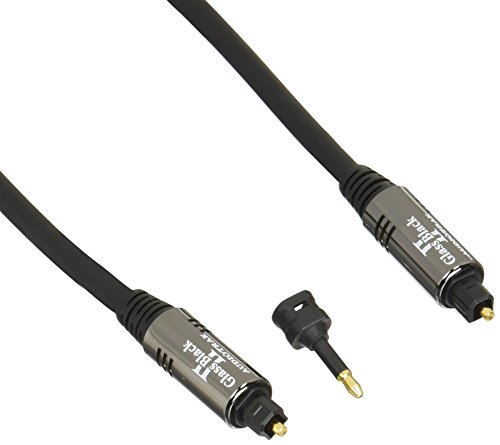
Glass fiber optical digital cable with premium materials but no measurable performance advantage over significantly cheaper alternatives
Overview
The Audiotrak Glass BlackII+ is a premium TOSLINK optical digital cable manufactured by WiseTech, featuring a high-purity glass fiber core designed for digital audio transmission. The cable supports 44.1kHz-384kHz 32-bit transmission with a temperature range of -40°C to 80°C. Available in multiple lengths (0.5m, 1.0m, 1.5m, 3.0m), it includes a square-to-round conversion connector and claims superior transmission characteristics compared to standard plastic fiber cables. Despite its premium construction and marketing claims of improved audio quality, independent measurements demonstrate no audible or measurable differences compared to significantly cheaper alternatives.
Scientific Validity
\[\Large \text{0.1}\]The Audiotrak Glass BlackII+ operates as a digital optical transmission cable supporting standard TOSLINK protocols with 44.1kHz-384kHz 32-bit capability. However, no manufacturer-provided measurement data exists for critical audio quality metrics including jitter, signal integrity, or transmission accuracy. Independent testing by Archimago comparing various TOSLINK cables (plastic, glass, and extended lengths) found no measurable differences in analog output from DACs or jitter performance using the Dunn J-Test [1]. The claimed benefits of “low jitter” and “superior audio characteristics” remain unsubstantiated by measurement data. With no scientifically audible effects demonstrated and claims contrary to independent measurement evidence, the performance falls significantly below the problematic level threshold according to the measurement criteria.
Technology Level
\[\Large \text{0.4}\]The Glass BlackII+ employs standard glass fiber optical transmission technology with quality materials and appropriate temperature specifications. While the product demonstrates in-house design by Audiotrak, the underlying technology represents mature industry implementation without proprietary innovations. The glass fiber construction, while superior to plastic in theoretical transmission characteristics, offers no technical differentiation that competitors cannot easily replicate. The purely analog/mechanical approach lacks integration with modern digital signal processing or advanced technologies. The product achieves reliable functionality but provides no technological advancement beyond established glass fiber construction methods, resulting in below-average technology level scoring.
Cost-Performance
\[\Large \text{0.2}\]At 55 USD for the 1m version based on current market pricing [3], the Glass BlackII+ faces significant cost-performance challenges when compared to equivalent alternatives. The Amazon Basics TOSLINK Digital Optical Audio Cable (6ft) at 8.99 USD [4] provides identical TOSLINK functionality with equivalent measured performance. Independent testing confirms no audible differences between glass and plastic optical cables in consumer applications [1]. Equipped with identical digital transmission capabilities supporting standard TOSLINK protocols, frequency response, jitter performance, and signal transmission quality are equivalent-or-better based on independent measurement data showing no performance differences.
Cost-Performance calculation: 8.99 USD ÷ 55 USD = 0.163 ≈ 0.2
The premium pricing cannot be justified by measurable performance improvements, resulting in poor cost-performance evaluation.
Reliability & Support
\[\Large \text{0.4}\]The Glass BlackII+ offers standard 2-year warranty coverage through WiseTech’s dealer-based support network. While glass fiber construction provides theoretical durability advantages for long-distance transmission, it introduces practical reliability concerns. Glass optical cables are inherently more fragile than plastic alternatives and prone to internal breakage from bending or twisting, which may not be easily visible due to their stiffness compared to flexible plastic alternatives [2]. The cable’s construction requires more careful handling due to reduced flexibility. Temperature specifications (-40°C to 80°C) meet standard requirements, but the glass core’s brittleness represents a reliability trade-off against the theoretical transmission benefits.
Rationality of Design Philosophy
\[\Large \text{0.2}\]The design philosophy emphasizes materials-based improvements claiming “superior audio characteristics” and “low jitter” without providing measurement verification [3]. This approach contradicts scientific audio evaluation principles by making audibility claims for elements that independent testing shows produce no measurable differences [1]. The majority of the product’s cost appears unrelated to measurable performance improvements, instead focusing on premium materials marketing. While glass fiber construction represents a conservative application of established technology, the lack of measurable advantages over significantly cheaper alternatives undermines the rationality of the premium pricing strategy. The philosophy relies on subjective claims rather than objective performance data, resulting in below-average rationality scoring.
Advice
The Audiotrak Glass BlackII+ represents a well-constructed optical cable using quality materials, but purchasing decisions should be based on objective performance rather than premium material claims. Independent measurements demonstrate no audible or measurable advantages over significantly cheaper plastic fiber alternatives like the Amazon Basics TOSLINK cable at approximately one-sixth the price. For users seeking reliable digital optical transmission, standard plastic fiber cables provide equivalent functionality with better flexibility and durability. The premium price cannot be justified by performance improvements, making budget alternatives the more rational choice for identical audio quality.
References
[1] Archimago, “MEASUREMENTS: TosLink digital optical audio cables,” Archimago’s Musings, May 2013, http://archimago.blogspot.com/2013/05/measurements-toslink-optical-audio.html, accessed September 2025
[2] EEVblog Forum, “Plastic vs glass fiber TOSLINK?” https://www.eevblog.com/forum/projects/plastic-vs-glass-fiber-toslink/, accessed September 2025, discussing glass cable stiffness and handling issues
[3] Amazon.com, “WiseTech AUDIOTRAK Glass Black2plus 1m,” https://www.amazon.com/dp/B07MZ7YFQ5, accessed September 2025
[4] Amazon.com, “Amazon Basics Toslink Digital Optical Audio Cable,” https://www.amazon.com/dp/B00NH11H38, accessed September 2025
(2025.9.6)
External Search
Check additional information and availability outside this site.