
Product Review
Crown Amcron DC-300A Series II
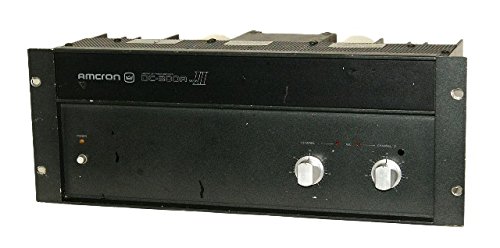
A legendary professional power amplifier from 1996, but shows significant technical obsolescence and cost-performance issues by modern standards
Overview
The Crown Amcron DC-300A Series II is a professional 2-channel power amplifier released in 1996. Developed by Crown (then under the Amcron brand), this unit delivers 150W into 8Ω loads and 250W into 4Ω loads, and was widely adopted in professional audio applications. It featured JTS (Junction Temperature Simulation) protection circuitry and a DC-coupled design for wide bandwidth characteristics. At its time of release, it was evaluated as an innovative design and has a history of use in many studios and live venues.
Scientific Validity
\[\Large \text{0.9}\]The measured performance still reaches transparent levels today. THD shows excellent values of less than 0.001% from 20-400Hz and 0.05% at 20kHz. The S/N ratio of 110dB is adequate by modern standards, and the frequency response is extremely flat at ±0.1dB from DC to 20kHz. IMD characteristics also clear the transparency level at less than 0.01%. These measured values fall well within the range that does not cause audible sound quality degradation, resulting in a high evaluation for scientific validity.
Technology Level
\[\Large \text{0.4}\]While advanced as a Class AB design for 1996, it falls below average by modern technology standards. The JTS protection circuit was innovative for its time but has become common technology today. With a basic analog circuit design, it lags behind modern GaN FET technology and Class D designs in terms of efficiency and miniaturization. Looking purely at technical achievement, no particularly superior proprietary technology is found when compared to modern amplifiers of equivalent output.
Cost-Performance
\[\Large \text{0.3}\]The current average price on the used market is around 350 USD. As a modern product with equivalent or superior output and measured performance, the Fosi Audio V3 (with an upgraded power supply) is available from 89.99 USD. The cost-performance score is calculated by dividing the price of the cheapest modern equivalent by the target product’s price. The calculation is 89.99 USD ÷ 350 USD ≈ 0.26, which rounds to 0.3. Due to the existence of numerous more affordable and high-performing alternatives, it significantly lags behind modern products in its pure performance-to-price ratio.
Reliability & Support
\[\Large \text{0.5}\]The product itself has high durability, and properly maintained units still operate today. However, with decades having passed since production ended, obtaining replacement parts has become difficult. Manufacturer support is also limited compared to current products, and repairs depend on specialized service providers. This represents standard support conditions for vintage products.
Rationality of Design Philosophy
\[\Large \text{0.4}\]While rational as a Class AB design for 1996, it is inefficient from a modern perspective. It is heavy, generates significant heat, and consumes substantially more power compared to modern Class D amplifiers. When equivalent measured performance can be achieved with modern technology in lighter, more efficient, and lower-heat designs, the rationale for it to exist as dedicated equipment becomes questionable. Considering its performance is within the range replaceable by modern general-purpose equipment and compact amplifiers, the rationality of its design philosophy falls below average.
Advice
The Crown Amcron DC-300A Series II remains an excellent product in terms of measured performance but faces serious issues with technical obsolescence and cost-performance. For those considering a purchase, choosing modern products like the Dayton Audio APA150 (199 USD) or the more affordable Fosi Audio V3 (from 89.99 USD) would provide a significantly superior price-to-performance ratio. The Fosi V3, in particular, can achieve comparable output with an appropriate power supply. If you already own one and it is properly maintained, continued use poses no problem, but you should consider repair costs and parts availability difficulties. For applications focused purely on audio fidelity, switching to modern alternatives is recommended. Unless you are a vintage enthusiast or value historical significance, practical users would be better served by modern equipment.
(2025.7.21)
External Search
Check additional information and availability outside this site.