
Product Review
DALI Kupid
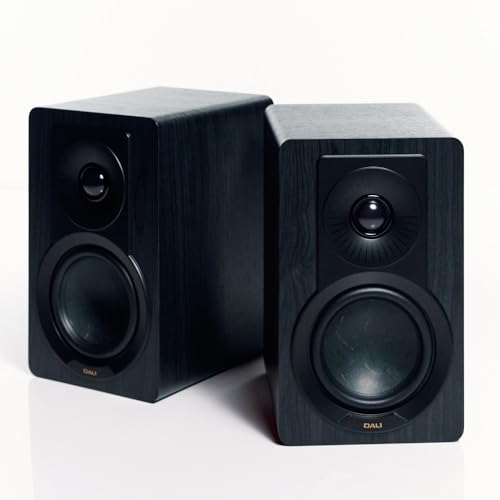
Compact 2-way passive bookshelf speaker (600 USD/pair) with conservative engineering, aesthetic-led design, and below-average cost-performance versus JBL Stage A130 at 200 USD/pair.
Overview
The DALI Kupid is a compact 2-way passive bass-reflex bookshelf loudspeaker released in October 2025, sold as a pair at 600 USD (US market) [1][3]. Manufactured by DALI (Danish Audiophile Loudspeaker Industries), a Denmark-based brand with over 40 years of in-house speaker design experience, the Kupid sits below DALI’s Spektor/Oberon/Opticon families and is positioned as the brand’s most accessible standalone Hi-Fi loudspeaker. It pairs a 4.5-inch paper/wood-fibre cone bass/midrange driver with a 26 mm soft-dome tweeter, crossed over at 2,100 Hz, and uses a rear-firing dual-flare bass-reflex port (53 Hz tune) intended to tolerate placement close to the wall. DALI offers it in five color-matched finishes [1][3].
Scientific Validity
\[\Large \text{0.6}\]DALI rates the Kupid at 63 Hz – 25 kHz (±3 dB) frequency response, sensitivity 83 dB (2.83V/1m), nominal impedance 4 Ω, and maximum SPL 103 dB [1]. Third-party anechoic measurements from SoundStage! Network at the National Research Council of Canada (NRC) include the full plotted frequency response (20 Hz–20 kHz, listening window and on-/off-axis), THD+N curve across 50 Hz–10 kHz, linearity deviation, impedance magnitude, and electrical phase [2]. NRC measured sensitivity at 82.0 dB (2.83V/1m, listening-window average 300 Hz–3 kHz), within normal method-difference of the manufacturer figure. The ±3 dB frequency-response window of 63 Hz–25 kHz meets the standard band for usage but does not approach excellent on-axis linearity. NRC reduced its standard THD test SPL from 90 dB to 85 dB to avoid damaging the small drivers and crossover, an explicit physical-headroom note; the resulting THD+N curve is comprehensive but indicates limited high-SPL margin. S/N ratio, SINAD, IMD, and crosstalk are not applicable to a passive loudspeaker. Overall measured performance is acceptable, sitting at the standard band for compact passive bookshelves without indicators of excellent linearity or distortion margin.
Technology Level
\[\Large \text{0.4}\]Every technology used in the Kupid is mature and widely available: a paper/wood-fibre cone (a DALI signature since the 1990s), a 26 mm soft-dome tweeter (industry-standard for decades), a dual-flare rear bass-reflex port (a refinement of 1990s flared-port designs used across the industry), and a conventional 2-way passive LC crossover with no DSP, no active electronics, and no software, cloud, or AI integration [1][3]. Notably, DALI’s actual patented innovation — the Soft Magnetic Composite (SMC) magnet system used in Oberon, Opticon, Rubicon, and Epicon — is not used here; the Kupid uses a conventional ferrite magnet, representing DALI’s lowest-tier motor implementation [3]. While the product is designed in-house in Denmark (and manufactured in China) and benefits from DALI’s substantial accumulated speaker-design know-how, no proprietary patent is claimed for this specific model, and none of the implemented technologies are scarce or differentiated enough that competitors would seek to follow. The implementation is straightforward to replicate by any established speaker manufacturer.
Cost-Performance
\[\Large \text{0.3}\]The current US market price for the DALI Kupid is 600 USD per pair [1]. The cheapest passive bookshelf speaker with equivalent-or-better user-facing functions and equivalent-or-better measured performance from a credible third-party lab is the JBL Stage A130 at 200 USD per pair [4]. The A130 provides identical user-facing function: 2-channel passive stereo, single-wire binding posts, rear-port near-wall placement compatibility, and operation within the same 40–120 W amplifier power range.
JBL Stage A130 demonstrates equivalent-or-better measured performance:
- Frequency Response deviation: ±3 dB ~55 Hz – 20 kHz (Klippel NFS spinorama, on-axis) vs DALI Kupid ±3 dB 63 Hz – 25 kHz (manufacturer; NRC anechoic plot 20 Hz–20 kHz corroborates usage-band linearity) — comparable on-axis linearity, with the A130 reaching lower in low-frequency extension [5].
- THD vs frequency: graph-based across the audible band in the Klippel NFS dataset, comparable distortion characteristics across 50 Hz – 10 kHz versus the NRC THD+N plot at 85 dB SPL for the Kupid — equivalent, with both products characterized by comprehensive graph-based data from credible labs [2][5].
CP = 200 USD ÷ 600 USD = 0.33.
Reliability & Support
\[\Large \text{0.8}\]The DALI Kupid carries a 5-year parts-and-labor warranty as standard for DALI passive loudspeakers, valid for the original purchaser [1]. The design is mechanically simple — a passive 2-way bookshelf with two drivers, an LC crossover, and a ported cabinet, with no active electronics — making it inherently robust and serviceable through driver and component replacement. DALI operates a worldwide distribution and dealer network providing manufacturer-backed support globally, with regional distributors handling warranty service. No widespread physical reliability issues, recalls, or service bulletins have been documented across major reviews and forums for the Kupid. Firmware updates are not applicable, as this is a passive analog loudspeaker.
Rationality of Design Philosophy
\[\Large \text{0.3}\]Released in October 2025 at 600 USD per pair, the Kupid is a purely passive 2-way bookshelf with no DSP, no room correction, no active amplification, and no wireless input — in an era when entry-level competitors at similar or lower price points commonly offer DSP-equipped active monitors, integrated streaming, and room-correction features. DALI’s own marketing places aesthetics — five color-coordinated finishes with color-matched cones and grilles — as a primary differentiation pillar, while functional cost allocation is only medium [1]. Notably, DALI’s patented SMC magnet, the company’s strongest proprietary contribution to lower-distortion driver design, is omitted in favor of a conventional ferrite magnet, indicating cost-cutting away from the very technology that would deliver measurable benefit. Sound-quality marketing relies on descriptive, non-quantified language (“fast, tight bass,” “distortion-free lows”) rather than published anechoic data; DALI itself does not publish spinorama measurements for the product. The technologies deployed are all mature and well-understood, but none are arranged to push measured performance forward versus the 2025 baseline. There are no occult claims, and the product is a legitimate functional speaker, but the combination of conservative passive-only engineering in a DSP-mature market and explicit aesthetic-over-performance cost allocation results in below-average rationality.
Advice
For a purely passive compact bookshelf at this price tier, alternatives with comparable measured frequency response and THD characteristics from credible third-party labs are available at one-third the price, such as the JBL Stage A130 at 200 USD per pair [4][5]. Buyers prioritizing measurable performance per dollar will find the value proposition weak. The Kupid’s case rests on aesthetic integration — the five color-matched finishes with color-matched cones — and on placement flexibility near a rear wall thanks to the dual-flare port. If those qualities are decisive for the use case (visible living-room or desktop placement where the finish is a primary criterion), the Kupid is a competent and reliable choice. For listeners seeking the most fidelity per dollar in a small room, allocate the budget toward a measurement-validated lower-cost passive (with an amplifier) or toward a DSP-equipped active alternative.
References
[1] DALI Speakers – Kupid Official Product Page – https://www.dali-speakers.com/en/products/kupid/kupid/ – accessed 2026-05-12 [2] SoundStage! Network – NRC Measurements: DALI Kupid Loudspeaker – https://soundstagenetwork.com/index.php?option=com_content&view=article&id=3033:nrc-measurements-dali-kupid-loudspeaker&catid=77:loudspeaker-measurements&Itemid=153 – accessed 2026-05-12 – NRC anechoic chamber, 2 m mic plotted at 1 m, tweeter axis no grille; THD+N at 85 dB SPL [3] ecoustics – KUPID by DALI: Compact, Colorful, and Minimalist Bookshelf Speakers – https://www.ecoustics.com/products/dali-kupid/ – accessed 2026-05-12 [4] Crutchfield – JBL Stage A130 Product Page (200 USD/pair) – https://www.crutchfield.com/p_109SA130AM/JBL-Stage-A130.html – accessed 2026-05-12 [5] Erin’s Audio Corner – JBL Stage A130 Klippel NFS Measurements – https://www.erinsaudiocorner.com/loudspeakers/jbl_stage_a130/ – accessed 2026-05-12 – Klippel Near-Field Scanner spinorama dataset
(2026.5.16)
External Search
Check additional information and availability outside this site.