
Product Review
DUNU DN 142
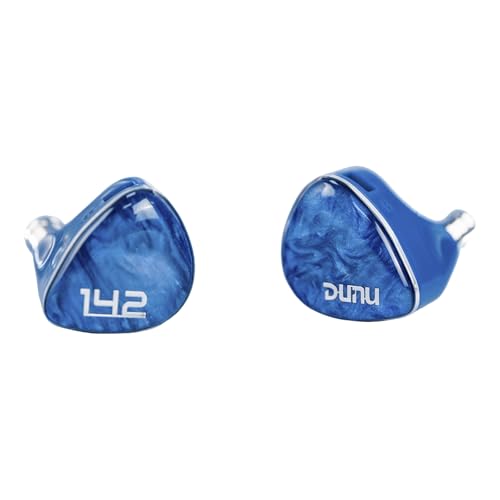
A tribrid IEM with genuine in-house engineering and a patented connector system, but no independent measurement data, a distortion specification at the boundary of concerning performance, and a design philosophy weighted toward aesthetic prestige over measurable results.
Overview
DUNU, founded in 1994 as an OEM manufacturer and operating under its own brand since 2006, positions the DN-142 as a mid-tier entry in its DN series at 249.99 USD. The product features seven drivers per side — one dynamic driver for low frequencies, four balanced armature drivers for midrange and treble, and two micro-planar drivers for ultra-high frequencies — managed by a four-way physical-plus-electronic crossover. It is marketed under the “Ao Bing” mythological theme and sold through DUNU’s official store and authorized distributors including HiFiGo and Bloom Audio [1].
Scientific Validity
\[\Large \text{0.5}\]The manufacturer’s sole published audio-quality-relevant specification is THD <0.5% at 1kHz [1], a value that sits at or near the boundary of concerning distortion performance for earphones. Frequency response is stated only as 5Hz–40kHz [1] without any ±dB tolerance, providing no basis for evaluating deviation from the Harman target curve. No S/N ratio, SINAD, IMD, or crosstalk figures are published. No independent third-party measurements from any established measurement laboratory are available as of the review date, leaving the manufacturer’s borderline THD figure as the only objective performance indicator available.
Technology Level
\[\Large \text{0.7}\]The DN-142 carries several genuine technology-level strengths. The Q-Lock Mini modular plug system is backed by confirmed patents (CNIPA ZL201821202295.0; WIPO WO2020019499A1) [1], representing proprietary intellectual property exclusive to DUNU. The acoustic design — driver configuration, crossover architecture, and tuning — is demonstrably in-house: DUNU operates professional acoustic measurement infrastructure including Brüel & Kjær systems and dedicated anechoic chambers. The accumulated manufacturing and acoustic engineering know-how across an established product line represents a meaningful barrier for new entrants to replicate.
These strengths are offset by several factors. The tribrid DD+BA+planar architecture, micro-planar drivers in IEMs, and 3D-printed resin shells via a HeyGears manufacturing partnership are all established, widely-adopted approaches in the sub-USD 300 IEM market as of 2025 — none qualify as cutting-edge. The Q-Lock system, while patented, has not been adopted by the broader industry after more than six years on the market, with MMCX and standard 2-pin connectors remaining dominant, indicating limited transferability. The silver-plated OCC Litz cable is positioned as a core technical feature but provides no demonstrated audible benefit.
Cost-Performance
\[\Large \text{0.1}\]This site evaluates based solely on functionality and measured performance values, without considering driver types or configurations.
The DN-142 is a passive wired IEM providing 3.5mm SE and 4.4mm balanced connectivity via its included Q-Lock Mini modular cable system, with no DSP, EQ, app control, or ANC.
The Truthear HOLA is available at 18.99 USD [2] and delivers equivalent passive wired IEM functionality with 3.5mm SE output. Its detachable 0.78mm 2-pin cable — the same connector standard as the DN-142 — allows upgrade to 4.4mm balanced via a standard aftermarket cable available for approximately 13 USD from major online retailers, for a normalized total of approximately 31.99 USD.
Performance comparison (provisional, as no independent third-party measurements exist for the DN-142):
- THD: HOLA ≤0.1% @1kHz [2][4] vs DN-142 <0.5% @1kHz [1] — HOLA demonstrates clearly better distortion performance
- Frequency response deviation from Harman target: HOLA has published third-party FR measurements from Crinacle showing a standard deviation of approximately 2.31 from the Harman target [3]; DN-142 provides only a 5Hz–40kHz frequency range specification without any Harman-referenced deviation data [1] — direct numeric comparison is not possible, but HOLA carries confirmed third-party FR data while the DN-142 does not
CP = 31.99 USD ÷ 249.99 USD = 0.128 → 0.1
Reliability & Support
\[\Large \text{0.4}\]The DN-142 carries a 1-year international warranty [1], below the typical 2-year industry standard. Support is routed primarily through authorized dealers worldwide rather than direct manufacturer service infrastructure; direct manufacturer contact is available via the official website. No RMA statistics, failure rate data, or MTBF figures are published for this specific model. The passive tribrid design is inherently free of active electronic component failure risks, and the detachable 0.78mm 2-pin cable is a user-replaceable standard component. Shell construction is described as seamless and solid in available product coverage, with no documented defects, recalls, or quality control alerts recorded as of the review date. Firmware does not apply to a passive IEM. The below-average warranty period is the primary factor driving the score below the baseline.
Rationality of Design Philosophy
\[\Large \text{0.2}\]The DN-142’s design philosophy is not oriented toward measurement-driven sound quality improvement. DUNU describes its tuning exclusively in subjective terms — “relaxed neutrality,” “never harsh,” “every tone true to its source” [1] — without reference to any measurable target curve. Available reviewer FR data indicates a V/U-shaped response that contradicts the stated source-accurate positioning [5]. The manufacturer simultaneously claims “ultra-low multi-driver distortion” while the published THD specification is <0.5% at 1kHz [1], a value near the boundary of concerning distortion performance for earphones — an internally inconsistent claim that is not supported by independent evidence.
A significant share of product cost is allocated to non-functional elements: mythology-themed packaging, collectible Ao Bing cards, and a silver-plated OCC Litz cable with no demonstrated audible benefit in controlled testing. The 7-driver-per-side architecture is cost-significant; however, high driver count does not inherently yield superior objective performance over well-tuned simpler designs, and this approach is more consistent with marketing prestige and perceived premium positioning than with measurable acoustic efficiency. The tribrid DD+BA+planar configuration was an established, widely-adopted market strategy by 2025, not an innovative direction. The absence of DSP, EQ, or any digital signal processing forgoes proven tools for measurable tuning accuracy.
On the positive side, the product avoids vacuum tubes, analog nostalgia architectures, or R2R designs; the Q-Lock Mini connector is a genuine, patented user convenience innovation; and 3D-printed resin shell manufacturing is a modern production method. These positive aspects do not offset the fundamental misalignment between cost allocation, unverifiable subjective claims, and the absence of a scientifically grounded performance improvement strategy.
Advice
Buyers considering the DN-142 at 249.99 USD should be aware that no independent third-party measurements from any established measurement laboratory are available. The sole published distortion figure — THD <0.5% at 1kHz — is near the boundary of concerning performance for earphones, and no Harman-referenced frequency response data exists to assess claimed tuning accuracy. Products with published third-party measurements and confirmed lower distortion are available at substantially lower prices in this category.
The Q-Lock Mini modular connector system and DUNU’s in-house acoustic engineering infrastructure are genuine technical differentiators. The modular termination system offers practical value for users who switch between 3.5mm and 4.4mm balanced outputs. However, the multi-driver architecture complexity, mythology-themed packaging, and premium cable materials do not correspond to demonstrable objective performance improvements. Buyers prioritizing objective measurement evidence and cost efficiency will find better-supported alternatives. Buyers specifically drawn to the Q-Lock Mini ecosystem or the 4.4mm/3.5mm modular convenience should verify whether the companion DN-242 model better matches their requirements before committing to the DN-142.
References
[1] DUNU - DN-142 Official Product Page - https://www.dunu-topsound.com/product-page/dn-142 - Accessed 2026-05-17
[2] Truthear - HOLA Official Product Page - https://truthear.com/products/hola - Accessed 2026-05-17 (Price USD 18.99; Manufacturer THD ≤0.1% @1kHz at 94dB)
[3] Crinacle / In-Ear Fidelity - Truthear HOLA Frequency Response Graph - https://crinacle.com/graphs/iems/truthear-hola/ - Accessed 2026-05-17 (Third-party FR measurement; standard deviation approximately 2.31 from Harman target)
[4] Prime Audio Reviews - Truthear HOLA Review - https://primeaudio.org/truthear-hola-review/ - Accessed 2026-05-17 (THD ≤0.1% confirmed)
[5] eCoustics - DUNU DN142 Review: An Electrifying IEM That Delivers Big Energy for the Price - https://www.ecoustics.com/reviews/dunu-dn142/ - Published 2026-02-18 (FR character observations)
(2026.5.19)
External Search
Check additional information and availability outside this site.