
Product Review
FiiO BTA30 Pro
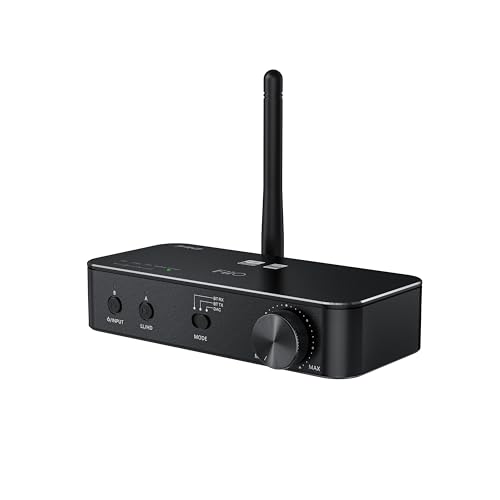
Desktop Bluetooth transceiver and USB DAC combining LDAC TX+RX, 384kHz/DSD256 USB decoding, and optical/coaxial digital I/O with strong measured performance and no cheaper equivalent-or-better alternative.
Overview
The FiiO BTA30 Pro is a desktop Bluetooth transceiver and USB DAC released in October 2021 as the successor to the original BTA30. It combines three operating modes — Bluetooth receiver (RX), Bluetooth transmitter (TX), and standalone USB DAC — within a 120 × 55 × 25.8 mm aluminum chassis priced at 129.99 USD [1][4]. FiiO is a Guangzhou-based manufacturer founded in 2007, with an in-house R&D operation reported at 300+ staff covering hardware, firmware, industrial design, and acoustics [1]. The product hub is built around four licensed ICs: the Qualcomm CSR8675 Bluetooth 5.0 SoC, the ESS ES9038Q2M DAC, an XMOS XU208 USB controller, and a CT7302EL DSP. Notable features include bidirectional LDAC support, USB PCM up to 384kHz/32-bit and native DSD256, optical and coaxial digital inputs, and RCA analog output. The Pro generation replaced the original BTA30’s AK4490 DAC following AKM supply constraints and added LDAC transmit capability that the prior model lacked.
Scientific Validity
\[\Large \text{0.8}\]Manufacturer specifications for USB DAC mode quote SNR ≥118 dB (A-weighted), THD+N <0.001%, and crosstalk ≥112 dB at 1 kHz into 10 kΩ, with frequency response of 5–90,000 Hz (-3 dB) [1]. Third-party measurements at Audio Science Review confirm DAC-mode SINAD around 102 dB and dynamic range around 113 dB, with THD+N exceeding the manufacturer’s claim at optimal output levels [2]. In TX mode, LDAC reaches approximately 111 dB SINAD with about 121 dB dynamic range, aptX HD measures around 108 dB SINAD, and SBC around 100 dB SINAD — all strong figures, although non-LDAC codecs exhibit a -54 dBFS muting behavior that compresses low-level dynamic range to roughly 98–105 dB. RX mode is limited to about 94–96 dB SINAD and 98 dB dynamic range, reflecting an apparent 16-bit effective resolution in the measured pairing. Frequency response (graph-based) is flat through the midrange with approximately -2 dB at 20 kHz. SINAD values clear the threshold for audible transparency across all three modes, with the main weakness being the RX-mode 16-bit ceiling and the non-LDAC TX muting behavior.
Technology Level
\[\Large \text{0.4}\]The BTA30 Pro is a system-integration product built entirely from established, licensed third-party silicon. The Qualcomm CSR8675 Bluetooth SoC dates from approximately 2015–2016 and was already being superseded by the Qualcomm QCC series at launch [1]. The ESS ES9038Q2M DAC (circa 2017–2018) was mainstream across budget-to-midrange DACs by 2021, and the XMOS XU208 is a standard USB audio controller widely used across the industry. The CT7302EL DSP performs routine upsampling to 384 kHz, a function whose audibility beyond source resolution is not established. Evaluated against current technology standards, none of these components are cutting-edge, and no FiiO proprietary patents or proprietary silicon were identified. Differentiating features such as bidirectional LDAC are firmware/configuration decisions on a licensed SoC, and competing integrators have replicated similar feature sets using the same off-the-shelf parts, indicating no durable competitive moat. Credit is given for FiiO’s in-house system design, firmware, three-mode integration, and the industrial design produced by a substantial internal engineering team; deductions reflect aging core silicon and easy replicability.
Cost-Performance
\[\Large \text{1.0}\]Review target price: 129.99 USD (US market, Walmart in-stock listing) [4].
After comprehensive search across pre-qualified candidates and broader web research, no product was identified that simultaneously provides bidirectional Bluetooth (TX+RX with LDAC), USB DAC operation up to 384kHz/DSD256, optical and coaxial digital inputs, and RCA analog output, with credible third-party measured performance, at any price below 129.99 USD. Standalone USB DACs (e.g., Topping D10s, Topping E30, Schiit Modi+) lack Bluetooth functionality entirely. Bluetooth receivers such as Topping BC3 (~69 USD) cover RX mode only — no TX, no optical/coaxial digital inputs, no USB DAC mode. Other transceiver candidates with TX+RX capability (1Mii B03Pro+ at ~149.99 USD, iFi Zen Blue 3 at ~375 USD) are both more expensive and lack independent third-party measurement verification. A bundled equivalent cannot be constructed because no third-party-measured standalone Bluetooth transmitter with optical/coaxial digital input exists at any price point.
CP = 1.0 (no cheaper equivalent-or-better product exists).
Reliability & Support
\[\Large \text{0.4}\]FiiO provides a 1-year warranty on the mainframe with an additional 1-month replacement period [1], which is short relative to the 2-year category norm. Support is offered by the manufacturer directly with a global network of regional sales agents, providing reasonable coverage but no in-person regional service centers — repair requires shipping the unit back to FiiO. Firmware update support has been minimal: two documented BTA30 Pro firmware releases were issued (V1.2 at launch in late 2021, V1.3 in March 2022) [5], with no further updates in over four years. FiiO’s own troubleshooting documentation acknowledges individual output port failures as a known failure mode, and the device’s design includes multiple ports, an external Bluetooth antenna, and a rotary volume knob — additional potential wear and failure points. No statistical RMA or MTBF data is available, so the failure rate is treated as unknown. The aluminum chassis is described as solid in build, partially offsetting the structural complexity.
Rationality of Design Philosophy
\[\Large \text{0.8}\]FiiO’s design approach for the BTA30 Pro is rational and measurement-oriented. The product uses mass-produced industry-standard ICs (ES9038Q2M, Qualcomm CSR8675, XMOS XU208) with no vacuum tubes, R2R ladder, Class A amplification, or other subjectively-motivated architectures. Marketing language centers on measurable properties — SNR, THD+N, codec support, sample-rate and bit-depth limits, and Hi-Res Audio / Hi-Res Audio Wireless certifications by the Japan Audio Society — rather than nostalgic or audiophile-myth claims. Costs are directed toward functional silicon, USB high-resolution decoding, bidirectional LDAC support, and DSP/app-based control rather than exotic materials or aesthetic decoration. The Pro generation is a genuine measurable improvement over the original BTA30: the ES9038Q2M replaces the AK4490, USB capability jumps from 16-bit/48kHz to 384kHz/32-bit and DSD256, and LDAC transmit, aptX LL, and bypass mode are added — a real generational progression rather than a cosmetic refresh [3]. Weak points include no proprietary silicon, no AI/cloud integration, and an upsampling-to-384kHz DSP claim without audibility evidence beyond source resolution. Overall the philosophy is sound, function-first, and consistent with a measurement-focused stance.
Advice
The BTA30 Pro is most justified for users who genuinely need its specific combination of capabilities: transmitting LDAC or aptX HD from an optical or coaxial digital source (TV, CD player, stereo receiver) to Bluetooth headphones or speakers, while also functioning as a USB DAC and Bluetooth receiver. In that role, no cheaper third-party-measured alternative exists, making the 129.99 USD asking price defensible on pure cost-performance grounds. Users who need only Bluetooth reception, with no TX requirement, will find cheaper measured options such as Topping BC3 at roughly 69 USD entirely adequate. Users who need only a USB DAC will obtain better measured performance from purpose-built DACs at similar prices. Be aware of two behavioral limitations confirmed by third-party measurement: RX mode operates at an effectively 16-bit ceiling regardless of source codec, and non-LDAC TX codecs mute output below -54 dBFS, which can affect quiet content. Firmware development appears to have ended in 2022, so do not expect further behavioral fixes.
References
[1] FiiO Official Product Page — BTA30 Pro — https://www.fiio.com/bta30pro — accessed 2026-05-08 (manufacturer specifications: SNR ≥118 dB A-weighted, THD+N <0.001%, crosstalk ≥112 dB, 1 kHz / 10 kΩ load)
[2] Audio Science Review — “Fiio BTA30 Pro Bluetooth Transmitter and Receiver + DAC Review” — https://www.audiosciencereview.com/forum/index.php?threads/fiio-bta30-pro-bluetooth-transmitter-and-receiver-dac-review.38910/ — accessed 2026-05-08 (test equipment: RME ADI-2 Pro fs R, Topping BC3 reference receiver, Virtins Multi Instrument)
[3] HiFiGo — “FiiO BTA30 Pro: Meet The Brand New Bluetooth Transceiver” — https://hifigo.com/blogs/news/fiio-bta30-pro-meet-the-brand-new-bluetooth-transceiver — accessed 2026-05-08 (release date October 29, 2021; launch price 119.99 USD)
[4] Walmart — FiiO BTA30PRO product listing — https://www.walmart.com/ip/FiiO-BTA30PRO-Bluetooth-Receiver-Portable-Transmitter-Stereo-Wireless-High-Resolution-aptX-LDAC-DSD256-Brand-New/313002121 — accessed 2026-05-08 (price 129.99 USD, in-stock)
[5] FiiO BTA30 Pro Firmware V1.3 + XMOS B15 Release — https://www.fiio.com/newsinfo/623956.html — accessed 2026-05-08 (released March 4, 2022)
(2026.5.15)
External Search
Check additional information and availability outside this site.