
Product Review
Final D8000
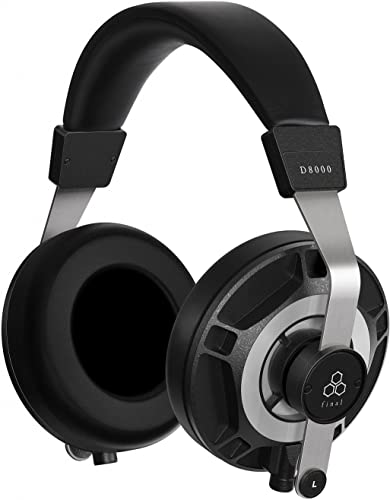
A flagship planar magnetic headphone featuring the proprietary AFDS technology. Despite genuine engineering innovation, frequency response deviates substantially from reference targets, equivalent measured performance is available at a fraction of the price, and the discontinued product carries significant reliability and support concerns.
Overview
The Final D8000, first announced at AXPONA 2017 and released in December 2018, was Final Audio (S’NEXT Co., Ltd.)’s inaugural flagship planar magnetic headphone, manufactured in-house at the company’s Kawasaki, Japan facility. Its central engineering claim is the proprietary AFDS (Air Film Damping System), which uses perforated metal screens positioned at precise distances on both sides of the planar diaphragm to create a controlled air buffer that prevents diaphragm-to-magnet contact during high-amplitude excursions. The housing is precision-milled aluminum-magnesium alloy. The product shipped with two OFC cables (1.5m/3.5mm and 3.0m/6.3mm), an aluminum headphone stand, and an aluminum attaché case. The D8000 has since been discontinued, superseded by the D8000 Pro Edition (2019) and D8000 DC (2024).
Scientific Validity
\[\Large \text{0.4}\]Third-party measurements from DIY-Audio-Heaven [2] show THD (2nd harmonic) below 0.2% at 85dB SPL — an upper bound limited by the measurement rig floor — and bass THD below 1%, both representing acceptable distortion performance. The manufacturer does not publish frequency response range or THD specifications for the D8000 [1].
Frequency response, however, exhibits a ~3–4dB presence dip around 3kHz, elevated energy in the 7–10kHz range, and rolloff above 16kHz, placing frequency response deviation well into problematic territory. As an open-back design, passive sound isolation measures approximately 0dB — inherent to the form factor but constituting a significant limitation compared to closed or sealed alternatives. The DIY-Audio-Heaven measurements were conducted under ambient noise conditions at a demo facility, introducing uncertainty into the THD figures; the distortion values are best treated as upper bounds. Two of the three applicable metrics — frequency response deviation and passive isolation — are at problematic levels, partially offset by acceptable THD performance.
Technology Level
\[\Large \text{0.6}\]The D8000 represents an unusual degree of vertical integration for a boutique audio manufacturer: Final designed both the product and the custom tooling required to produce it, including a proprietary diaphragm formation machine and diaphragm tension meter at their Kawasaki facility. The AFDS (Air Film Damping System) — adapting air-film damping principles from high-end studio condenser microphone engineering to a planar magnetic headphone driver — was genuinely novel at its 2018 release and remains unreplicated by any other headphone manufacturer as of 2026. Development employed finite element method (FEM) simulation and laser Doppler vibrometry rather than purely empirical tuning, reflecting a scientifically grounded cross-domain engineering process. These factors represent substantial accumulated manufacturing know-how.
Several factors moderate the score. No formal patents protecting AFDS have been confirmed in public records, meaning technical exclusivity rests solely on practical know-how rather than legal protection. The product is now approximately eight years old and discontinued, and does not represent cutting-edge work from recent years. The absence of competitor adoption appears to reflect commercial dynamics — DSP achieves comparable distortion reduction far more cheaply — rather than a technically hard-to-replicate moat. The product is entirely analog-mechanical with no digital integration whatsoever. The etched aluminum voice coil diaphragm construction, while well-executed, is standard practice across the planar magnetic industry and contributes no additional differentiation.
Cost-Performance
\[\Large \text{0.0}\]This site evaluates based solely on functionality and measured performance values, without considering driver types or configurations.
The Final D8000 was last sold new at USD 3,799 [1]. The HiFiMAN HE400se is currently available at USD 109 [5] and provides equivalent user-facing functions: a wired over-ear passive headphone with no ANC, no wireless, and standard 3.5mm connectivity.
Performance comparison based on third-party measurements:
- THD: HE400se below 0.2% upper bound (rig floor limited, DIY-Audio-Heaven) [4] vs D8000 below 0.2% upper bound (same platform) [2] — equivalent
- Frequency response deviation: HE400se STD 1.98 dB [3] vs D8000 estimated STD above 3.0 dB (qualitative: ~3–4dB dip at 3kHz; peaks 7–10kHz; rolloff above 16kHz) [2] — HE400se is better
- Passive isolation: both open-back designs, approximately 0dB — equivalent
The HE400se demonstrates equivalent-or-better measured performance across all applicable metrics at USD 109, making it the cheapest confirmed equivalent-or-better option.
CP = 109 USD / 3,799 USD = 0.0287
Rounded to the first decimal place: 0.0.
Reliability & Support
\[\Large \text{0.2}\]US customers receive a 3-year manufacturer warranty with product registration within 30 days of purchase; standard coverage without registration is 90 days. Post-warranty repair costs are stated at 20–30% of retail for repairs and 30–50% for unit replacement — approximately USD 760–1,900 at last retail price. One documented out-of-warranty case (Australia, 2024) received a repair quote of approximately USD 2,600, which the owner described as prohibitively high. Support is primarily dealer-based; no documented global manufacturer support infrastructure exists, and the aforementioned Australian case reported non-responsiveness from both the authorized distributor and Final Inc. directly.
Two product-specific issues on the original D8000 have been publicly acknowledged by the manufacturer: first, a driver solder joint failure under high bass load, identified as a design constraint related to European volume-limiting requirements and subsequently addressed in the D8000 Pro redesign; second, diaphragm-to-magnet contact rattle at extreme SPLs, which Final has stated is expected behavior above a certain volume threshold and not grounds for driver replacement. Both are core structural issues confirmed by the manufacturer, not isolated anecdotes.
The original D8000 was discontinued circa 2019. As of 2026, approximately seven years have elapsed since discontinuation with no official post-discontinuation parts-availability or repair-support commitment.
Rationality of Design Philosophy
\[\Large \text{0.5}\]The AFDS (Air Film Damping System) represents a genuine mechanical innovation: applying air-film damping principles from high-end studio microphone engineering to a planar magnetic headphone driver to suppress diaphragm over-excursion and reduce bass distortion. Development used FEM simulation and laser Doppler vibrometry, reflecting a scientifically grounded methodology. As of 2026, no competing manufacturer has replicated the approach, indicating genuine technical originality rather than incremental refinement.
The broader design philosophy, however, allocates a substantial portion of the USD 3,799 price to materials quality (precision-machined aluminum-magnesium alloy chassis, Toray ultrasuede ear pads), in-house craftsmanship infrastructure, and accessories (aluminum attaché case, aluminum stand) — with performance and function investment rated at medium while materials and manufacturing/craftsmanship are both rated high. Competing headphones with equivalent or better measured performance are available at USD 109. No DSP, software tuning, or any digital signal processing is employed; the design philosophy explicitly favors analog-mechanical heritage-product positioning over cost-optimized acoustic performance. Model progression (D8000 → D8000 Pro → D8000 DC) delivered some genuine technical improvement — the Pro addressed the documented driver solder joint failure and strengthened AFDS — but price increases of approximately 32–40% substantially exceeded the acoustic performance gains. The innovative AFDS element and the non-acoustically-productive cost structure largely offset each other.
Advice
Buyers considering the Final D8000 on the secondary market should weigh several material factors. Frequency response deviates substantially from neutral: the ~3–4dB presence dip at 3kHz and elevated 7–10kHz energy represent a significant departure from flat reproduction, and the open-back form factor provides essentially no passive isolation. These are inherent acoustic characteristics of the product, not incidental defects.
From a practical standpoint, the D8000 has been discontinued for approximately seven years, with no official post-discontinuation parts availability commitment. Two design issues — driver solder joint failure and diaphragm rattle — were acknowledged by Final and addressed in successor models but remain present in original D8000 units. Post-warranty repair costs are high relative to the headphone market broadly, and global support infrastructure is limited. For buyers whose primary goal is accurate headphone reproduction with reliable current manufacturer support, options with demonstrably better frequency response accuracy are available at substantially lower prices. The D8000 is most relevant to buyers who specifically value the proprietary AFDS mechanical engineering approach or the company’s craftsmanship-oriented design philosophy, and who are prepared for the practical implications of owning a discontinued product.
References
[1] Final — D8000 Official Product Page — https://snext-final.com/en/products/detail/D8000 — accessed 2026-05-20
[2] DIY-Audio-Heaven — Final D8000 Measurements — https://diyaudioheaven.wordpress.com/headphones/measurements/final/d8000/ — accessed 2026-05-20 — 85dB SPL; ambient noise at demo facility; proprietary measurement rig
[3] Reference Audio Analyzer — HiFiMAN HE400se V2 — https://reference-audio-analyzer.pro/en/report/hp/hifiman-he400se-v2.php — accessed 2026-05-20
[4] DIY-Audio-Heaven — HiFiMAN HE400se Measurements — https://diyaudioheaven.wordpress.com/headphones/measurements/hifiman/he400se/ — accessed 2026-05-20 — same measurement platform as [2]
[5] Amazon — HiFiMAN HE400se (B08Z2SK5C4) — https://www.amazon.com/HIFIMAN-Audiophiles-Great-Sounding-Sensitivity-Comfortable/dp/B08Z2SK5C4 — accessed 2026-05-20; price USD 109
(2026.5.23)
External Search
Check additional information and availability outside this site.