
Product Review
Grace Design m900
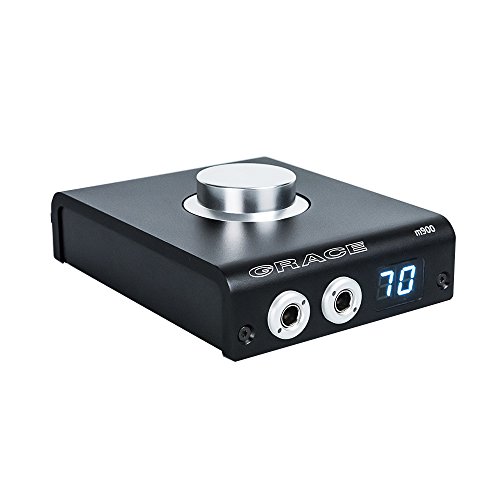
Grace Design m900 is a compact USB DAC, headphone amplifier, and stereo preamp/monitor controller assembled in Lyons, Colorado. Audio Precision-based measurements confirm transparent-level performance, but a current-generation alternative delivers equivalent-or-better metrics at well under half the price.
Overview
The Grace Design m900 is a compact desktop and portable USB DAC, headphone amplifier, and stereo preamp/monitor controller designed, assembled, and supported in Lyons, Colorado, USA. Grace Design is a boutique pro-audio manufacturer founded in 1994 by Michael and Eben Grace, with roots in microphone preamplifiers and larger monitor controllers (m902/m903/m920/m905/m908). The m900 distills that monitor-controller lineage into a small, single-PCB unit and was launched around 2016–2017. It carries USB (PCM up to 384 kHz, DSD256), S/PDIF coaxial (up to 192 kHz), and TOSLINK (up to 96 kHz) inputs, dual 1/4” headphone outputs and RCA line outputs, a crossfeed circuit, four selectable reconstruction filters, channel balance trim, and six monitoring modes [1][2].
Scientific Validity
\[\Large \text{0.8}\]Manufacturer specifications include THD+N <0.002% (line out, 1 kHz), dynamic range 115 dB A-weighted, crosstalk <-98 dB at 1 kHz, frequency response 0.5 Hz–45.9 kHz (±3 dB at 96 kHz sampling), and headphone output impedance 0.08 Ω [1]. Independent Audio Precision measurements published by Sound on Sound report THD of 0.0003% (1 kHz, line out) and A-weighted dynamic range of 117.5 dB (AES17), with 32-tone multi-tone IMD artefacts all below -100 dBu [2]. Audio Science Review places the unit in its top DAC tier on FFT and dashboard plots, with very low jitter and excellent linearity, while measuring a 1.2 Ω headphone output impedance and roughly 1 W into 33 Ω [3]. Almost all measured indicators are excellent, with measured dynamic range comfortably clearing the m900’s own specification, although a default reconstruction filter showed an ultrasonic oscillation artefact in ASR’s testing and overall performance is no longer best-in-class versus current 130+ dB dynamic range designs.
Technology Level
\[\Large \text{0.5}\]The m900 is an original Grace Design product, designed and assembled in-house in Lyons, Colorado, which justifies recognition for in-house engineering and three decades of monitor-controller know-how. However, every major signal-chain element relies on established, widely-available building blocks: an AKM AK4490 32-bit delta-sigma DAC released in 2014 and since superseded twice by the AK4493 and AK4499; an asynchronous USB clock-master implementation that has been industry baseline since roughly 2010; a transimpedance headphone amplifier topology used by multiple competitors (Benchmark HPA4 and others); and a crossfeed circuit whose underlying concept long predates the product [1][2][3]. No m900-specific patents were identified, and current competitors at a fraction of the price exceed its measurements, indicating no lasting competitive moat. The result is a competent but unremarkable implementation built from now-mature, commodity components.
Cost-Performance
\[\Large \text{0.4}\]The current US market price of the Grace Design m900 is 727 USD [1]. The cheapest equivalent-or-better single-box alternative identified is the Topping DX5 II at 299 USD [4], which provides USB, S/PDIF coaxial, and TOSLINK inputs, dual SE 1/4” headphone outputs, RCA preamp output, a headphone crossfeed function, volume control with preamp mode, and selectable reconstruction filters, plus additional balanced 4.4 mm and 4-pin XLR headphone outputs, 10-band parametric EQ, Bluetooth (LDAC/aptX Adaptive), 12 V trigger, and remote control.
DX5 II demonstrates equivalent-or-better measured performance per Audio Precision testing [5]:
- THD: ~0.00006% vs m900’s 0.0003% (DX5 II better)
- S/N Ratio (A-weighted dynamic range): ~133 dB vs m900’s 117.5 dB (DX5 II better)
- IMD: multi-tone artefacts at or below -100 dBu, equivalent to m900
- Crosstalk @ 1 kHz: ~-110 dB class vs m900’s <-98 dB (DX5 II better)
- Frequency Response: flat across the audible band on both, equivalent
- Headphone output power @ 32 Ω: >2,000 mW balanced vs m900’s ~950 mW high-power mode (DX5 II better)
- Headphone output impedance: sub-1 Ω class on both, effectively zero-ohm
CP = 299 USD ÷ 727 USD = 0.41.
Reliability & Support
\[\Large \text{0.8}\]Grace Design provides a 5-year transferable limited warranty, well above the 2-year industry baseline, with in-house manufacturer repair from Lyons, Colorado for US customers and distributor-based service internationally [1]. Build construction is a compact metal chassis with no moving parts beyond the rotary encoder and connectors, and long-term ownership reports across the m9XX/m900 family over 5+ years indicate strong durability with no systemic hardware failures and no recalls or service bulletins [3]. Early firmware quirks — an occasional DFU power-sync failure and reversed L/R channels on USB DSD playback — were resolved in subsequent firmware updates. Support is manufacturer-direct in the US but distributor-based internationally rather than a true global manufacturer network, and firmware updates are issued only rarely, so neither factor adds further credit. No statistical RMA or MTBF data exists, so failure-rate adjustments are not applied.
Rationality of Design Philosophy
\[\Large \text{0.7}\]The m900’s design approach is fundamentally measurement-focused and engineering-driven. Published specifications — THD+N <0.002%, dynamic range 115 dB A-weighted, output impedance 0.08 Ω, asynchronous USB clock-master — are concrete and audibility-relevant, and Sound on Sound’s and ASR’s Audio Precision measurements either met or exceeded them [1][2][3]. The signal chain relies entirely on scientifically defensible choices for 2016–2017: a current-generation delta-sigma DAC, asynchronous USB, a transimpedance headphone stage with near-zero output impedance, and integrated monitor-controller functions (crossfeed, mono sum, L/R swap, channel balance, line preamp) that justify the unit’s existence as dedicated equipment versus a generic smartphone-plus-DAC chain. Costs are largely directed at function and performance, with a moderate but not excessive boutique/US-assembly premium. There are no vacuum tubes, no R2R ladder, no analog-medium nostalgia, and no claims of audibility for scientifically inaudible elements. Modest negatives: company-level marketing language about “musicality” is subjective rather than scientific, and the line has stagnated for nearly a decade — the AK4490 has been superseded twice by AKM since release, yet no measurably better successor has appeared.
Advice
The m900 delivers transparent measured performance, a robust 5-year transferable warranty, in-house US repair, and a feature set tailored to studio monitoring workflows — dual headphone outputs, six monitoring modes, channel balance, crossfeed, and RCA preamp out. If the dedicated mono-sum / L+R swap / solo-L / solo-R buttons and US-built construction are operational requirements, the m900 is a fully functional choice. If those specific monitor-controller buttons are not required, the Topping DX5 II at 299 USD provides equivalent-or-better measurements with broader I/O (balanced headphone outputs, Bluetooth, parametric EQ, remote control) at 41% of the m900’s price [4][5]. Buyers paying near 727 USD are therefore paying primarily for the dedicated monitor-controller ergonomics, US assembly, and warranty length rather than for higher measured sound quality.
References
[1] Grace Design — m900 official product page - https://gracedesign.com/products/monitor-controllers/m900 - accessed 2026-05-18
[2] Sound on Sound — Grace Design m900 review (Hugh Robjohns) - https://www.soundonsound.com/reviews/grace-design-m900 - accessed 2026-05-18 - Audio Precision test set; AES17 dynamic range; -110 dBu reference for THD
[3] Audio Science Review — Review and Measurements of Grace Design m900 DAC & Amp - https://audiosciencereview.com/forum/index.php?threads/review-and-measurements-of-grace-design-m900-dac-amp.6470/ - accessed 2026-05-18 - Audio Precision rig; DAC dashboard, jitter, linearity, headphone power and output impedance
[4] Topping Store — DX5 II product page - https://www.topping.store/products/topping-dx5-ii-hi-res-dac-headphone-amp-combo - accessed 2026-05-18
[5] Audio Science Review — Topping DX5 II Balanced DAC and Headphone Amp Review - https://www.audiosciencereview.com/forum/index.php?threads/topping-dx5ii-balanced-dac-and-headphone-amp-review.64264/ - accessed 2026-05-18 - Audio Precision rig
(2026.5.21)
External Search
Check additional information and availability outside this site.