
Product Review
HiFiMAN HE1000 V2
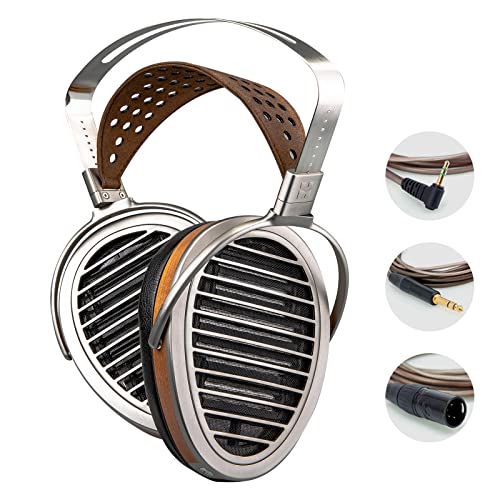
Genuine in-house planar magnetic engineering with multiple patents, but measured acoustic performance does not justify the 1,399 USD price when equivalently-performing alternatives are available at a fraction of the cost.
Overview
The HiFiMAN HE1000 V2 is an open-back over-ear headphone currently priced at 1,399 USD, incorporating Stealth Magnet technology added in a production revision of the chassis originally launched in 2016 at 2,999 USD. HiFiMAN, founded in 2007 by Dr. Fang Bian, has been a central figure in commercializing planar magnetic transducer technology for the consumer headphone market. The current iteration represents a substantial price reduction from the original launch MSRP while incorporating driver-level upgrades through the Stealth Magnet revision. Manufacturer specifications list 35 Ohm impedance, 90 dB sensitivity, and 420g weight.
Scientific Validity
\[\Large \text{0.5}\]Third-party measurements from SoundStage! Network and DIY Audio Heaven provide credible acoustic performance data. THD measures below 0.5% at normal listening levels across the audio band [3], approaching the limit of acceptable distortion performance for this product category. Under an extreme test condition of 100 dBA pink noise, THD reaches approximately 1% at 20 Hz [2] — this reflects a high-stress scenario rather than typical use, but indicates limited headroom. Frequency response deviation from the Harman over-ear 2018 target is 2.19 dB (graph-derived from third-party FR measurement data [2][3]), placing it at a mid-range level of target conformance — neither excellent nor significantly problematic. The manufacturer publishes a frequency response range of 8–65,000 Hz [1]; no manufacturer THD or S/N ratio figures are specified. As a fully open-back design, sound isolation is essentially absent — SoundStage! Network confirmed no meaningful attenuation from ambient sound [2]. This is poor isolation inherent to the open-back form factor. With THD approaching the boundary of acceptable performance and near-zero isolation, overall measured performance sits at the midpoint between adequate and poor.
Technology Level
\[\Large \text{0.8}\]The HE1000 V2 is an entirely in-house design. HiFiMAN holds patents on both the “Window Shade” horizontal-slat driver protection grille — designed to reduce secondary acoustic reflections from the grille structure — and the Stealth Magnet technology, in which magnets are shaped to allow sound waves to pass through the magnetic array with reduced diffraction. These technologies are proprietary to HiFiMAN and are not found in competing manufacturers’ current products. The core driver architecture, comprising an ultra-thin planar magnetic diaphragm and an asymmetrical double-sided magnetic circuit, was developed internally over approximately seven years per the company’s own account, representing substantial accumulated engineering expertise in planar magnetic transducer design that would require new entrants multiple years to replicate. As of 2026, however, neither the nanometer diaphragm concept (commercialized circa 2015) nor the Stealth Magnet technology (introduced circa 2021) qualifies as cutting-edge. The product is a fully passive analog transducer with no digital, software, or AI integration. The underlying engineering is sophisticated and genuinely differentiated, though the platform has matured since its introduction.
Cost-Performance
\[\Large \text{0.1}\]This site evaluates based solely on functionality and measured performance values, without considering driver types or configurations.
The HiFiMAN HE1000 V2 is priced at 1,399 USD [1]. The HiFiMAN HE400se is available at 109 USD (Amazon US [5]) and provides equivalent-or-better measured performance as a passive wired open-back headphone with the same fundamental connectivity (3.5mm, 6.3mm adapter, no DSP, no wireless, no ANC).
Third-party measurements confirm the HE400se delivers THD of 0.2% [4] versus the HE1000 V2’s below 0.5% [3] — the HE400se performs clearly better on distortion. Frequency response deviation from the Harman over-ear 2018 target is 1.98 dB for the HE400se versus 2.19 dB for the HE1000 V2 (graph-derived from FR measurement data [4][2][3]) — the HE400se again shows better target conformance. Both are open-back designs with equivalent sound isolation (~0 dB) [2]. The HE1000 V2 includes a 4-pin XLR balanced cable not bundled with the HE400se; this minor gap is closable via an aftermarket balanced cable at approximately 15–30 USD, which does not materially affect the calculation.
CP = 109 USD / 1,399 USD = 0.0779, rounded to 0.1.
Reliability & Support
\[\Large \text{0.6}\]HiFiMAN provides a 3-year limited warranty covering manufacturing defects under normal use, with repair or replacement at no charge [1]. An additional 6-month extension is available through product registration. Support is handled directly by HiFiMAN globally through multiple contact channels, with an online service portal [1]. Replacement cables (standard recessed 3.5mm connector type) and ear pads are available through both HiFiMAN’s official accessories store and numerous third-party vendors, providing reasonable parts continuity. The HE1000 V2’s mechanical design is inherently complex: a multi-element adjustable headband with gimbal hinges, a delicate ultra-thin diaphragm, and dual-sided magnet arrays introduce meaningfully more potential failure points than simpler headphone constructions. User community reports document patterns of headband adjustment mechanism failure, driver channel loss developing over time, connector intermittency, and early ear pad deterioration. These are anecdotal reports without statistical failure rate data, but they represent a consistent pattern across multiple independent accounts. No recalls or official service bulletins have been identified.
Rationality of Design Philosophy
\[\Large \text{0.3}\]The HE1000 V2’s design approach is mixed. Core driver engineering — ultra-low-mass planar magnetic diaphragm, asymmetrical magnetic circuit to reduce acoustic reflections within the driver, and aerodynamically shaped magnets to minimize wave diffraction — is grounded in established physical principles for controlling acoustic distortion. HiFiMAN has reduced the retail price from 2,999 USD at launch to 1,399 USD while incorporating the Stealth Magnet upgrade, demonstrating active cost rationalization over the product lifecycle.
However, substantial cost is directed toward non-acoustic premium materials: real wood earcup frames, CNC-milled metal headband components, and a leather-lined carrying case with a multi-termination cable set. These elements do not improve measured acoustic performance and represent budget allocation away from audibility-relevant engineering. The manufacturer markets the 8Hz–65,000 Hz frequency response specification as a product feature, despite extension above 20kHz providing no audible benefit — this is a specification claim used as a selling point for an inaudible characteristic. At 1,399 USD in 2026, the product remains fully passive with no DSP or EQ capability. Third-party measurements confirm elevated treble in the 5–8 kHz region [2][3] that users cannot address without external processing equipment; the passive-only design offers no path to user correction at this price point.
Advice
The HiFiMAN HE1000 V2 sits in a difficult position: its proprietary technology platform is genuine, but the measured acoustic performance does not justify the 1,399 USD price point. The HiFiMAN HE400se at 109 USD delivers lower measured distortion (0.2% vs. below 0.5% THD) and better frequency response target conformance (1.98 dB vs. 2.19 dB Harman deviation) as a passive wired open-back headphone.
Buyers specifically drawn to the HE1000 V2’s physical attributes — larger earcup dimensions, premium build materials, or the included multi-termination cable — should evaluate whether those attributes justify a price difference of approximately 13× over a product with objectively superior measured performance. For users prioritizing open-back planar magnetic sound with correction capability, pairing a lower-cost headphone with a DSP-capable amplifier or software EQ would address the measured frequency response deviations that the HE1000 V2’s passive architecture cannot self-correct.
References
[1] HiFiMAN - HE1000 V2 Official Product Page - https://www.hifiman.com/products/detail/267 - accessed 2026-06-05
[2] SoundStage! Network - HiFiMan HE1000 V2 Headphones - https://www.soundstagenetwork.com/index.php?option=com_content&view=article&id=1624:hifiman-he1000-v2-headphones&catid=263&Itemid=203 - accessed 2026-06-05 - G.R.A.S. Model 43AG ear/cheek simulator, Clio 10 FW audio analyzer, no compensation curve applied
[3] DIY Audio Heaven - HE-1000 V2 Measurements - https://diyaudioheaven.wordpress.com/headphones/measurements/hifiman/12890-2/ - accessed 2026-06-05
[4] DIY Audio Heaven - HiFiMAN HE400se Measurements - https://diyaudioheaven.wordpress.com/measurements/hifiman/he400se/ - accessed 2026-06-05
[5] Amazon US - HiFiMAN HE400se - https://www.amazon.com/HIFIMAN-Audiophiles-Great-Sounding-Sensitivity-Comfortable/dp/B08Z2SK5C4 - accessed 2026-06-05; price 109 USD
(2026.6.8)
External Search
Check additional information and availability outside this site.