
Product Review
HiFiMAN HE1000se
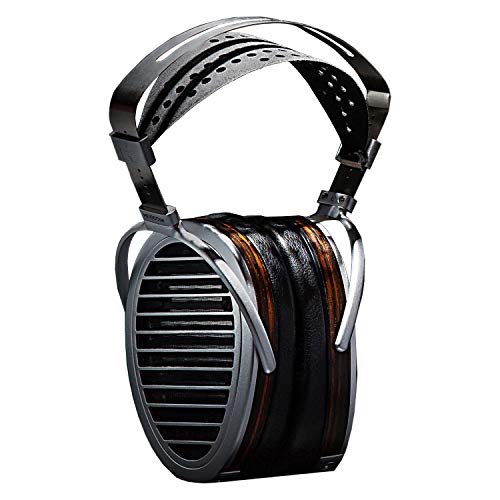
Flagship-adjacent open-back planar headphone with borderline THD and a bright tonal tilt at 1,699 USD; vastly cheaper alternatives match or exceed its measured performance.
Overview
HIFIMAN, founded by Dr. Fang Bian, has been a major player in consumer planar magnetic headphones since the late 2000s. The HE1000 line was introduced in 2015 as a reference flagship, and the HE1000se (Special Edition) launched in September 2018 at 3,499 USD MSRP, slotting beneath the Susvara [1]. The product is a passive, wired over-ear open-back planar magnetic headphone with bundled 3.5 mm, 6.35 mm, and 4-pin XLR cables. Eight years after release, the SE has been repositioned to roughly 1,699 USD at authorized US retailers [3].
Scientific Validity
\[\Large \text{0.5}\]Manufacturer specifications publish a frequency range of 8–65,000 Hz, 35 Ω impedance, and 96 dB/mW sensitivity, without an explicit ±dB window or THD/S-N figures [1]. Third-party measurements from Soundnews show overall THD of 0.25%, with the mid–treble band ranging 0.2–0.5% and bass-region distortion reportedly higher still [2]. Frequency-response measurements show a very clean trace from 20 Hz to about 1 kHz, with elevation in the upper treble; Soundnews notes the most sensitive band of hearing is elevated by about 2.5 dB relative to other HIFIMAN models in this region [2]. Channel matching is within 2 dB across the band except for a narrow deviation between 7.5–8.5 kHz [2]. Overall measured performance is moderate: THD is borderline and tonal deviation from a neutral target is non-trivial.
Technology Level
\[\Large \text{0.7}\]HE1000se combines HIFIMAN’s proprietary Stealth Magnet array, NsD nanometer-thickness diaphragm with sub-micron conductor traces, the patented Window Shade open-back grille, and an asymmetric teardrop earcup — all designed and manufactured in-house [1][2]. Multi-generation iteration (HE1000 V1 2015 → V2 ~2017 → SE 2018 → Stealth 2022 → Unveiled 2024) demonstrates substantive accumulated planar-magnetic engineering know-how. However, by 2026 the same stealth-magnet topology and NsD diaphragm have cascaded down to Edition XS, Ananda Stealth, and Arya Stealth/Organic at far lower price points, so what was distinctive at launch is now common across HIFIMAN’s own range and broadly replicable elsewhere. As a fully passive analog product without DSP or digital integration, it does not benefit from contemporary digital tuning tools that competitors increasingly offer. The engineering remains strong, but it no longer represents industry-leading exclusivity.
Cost-Performance
\[\Large \text{0.1}\]This site evaluates based solely on functionality and measured performance values, without considering driver types or configurations.
Current US street price is 1,699 USD [3]. The cheapest equivalent-or-better alternative on measured performance is the HIFIMAN HE400se at 109 USD [4], with an aftermarket 4-pin XLR balanced cable (≈30 USD) added to normalize the bundled-cable gap, for a total comparator price of 139 USD. Both are passive over-ear open-back wired headphones with detachable dual-entry cabling and 3.5 mm + 6.35 mm single-ended terminations, so user-facing functions are equivalent after cable normalization. The HE400se demonstrates equivalent-or-better measured performance:
- THD: 0.25% (HE1000se, Soundnews [2]) vs lower THD at normal listening levels (HE400se, ASR [5]) — comparator better
- Frequency response: HE400se largely complies with ASR’s target curve (ASR [5]); HE1000se shows pronounced upper-treble elevation relative to its flat midrange (Soundnews [2]) — comparator better on tonal balance consistency
CP = 139 USD / 1,699 USD = 0.08
Reliability & Support
\[\Large \text{0.5}\]Base US manufacturer warranty is 1 year per the Headphones.com retailer specification table, with an optional +6-month extension available through product registration [3]. One year falls below the typical two-year industry norm. The device is mechanically simple — passive transducer, no electronics, no firmware, user-replaceable detachable cables and earpads — which favors long-term durability absent electronic failure modes. Documented user-forum reports describe headband-detent wear, occasional cable-socket failures around the 1.5-year mark, and earpad-skin separation from the foam core, but these are anecdotal rather than statistical RMA data. Manufacturer-direct support exists but is region-bound: service is tied to the country of original purchase, limiting global portability.
Rationality of Design Philosophy
\[\Large \text{0.5}\]The engineering targets — back-wave diffraction reduction (Stealth Magnet) and moving-mass reduction (NsD diaphragm) — address real planar-magnetic mechanisms. The SE measurably exceeded the V2 (sensitivity raised from 90 to 96 dB/mW), and HIFIMAN has actively cascaded the same core technologies down to far cheaper models while repositioning the SE’s own street price from 3,499 USD to roughly 1,699 USD, supporting active cost reduction and continued performance progression [1][3]. Offsetting these positives, HIFIMAN publishes no measurement charts on the official page, frames tuning around subjective qualities (“purity,” “airiness”) rather than a documented target curve, and allocates substantial cost to cosmetic and material premium (wood inlay, hand-polished CNC metal). The approach remains fully passive analog with no DSP, EQ, or app integration despite such tools being mature and demonstrably effective for headphone tuning.
Advice
Prospective buyers attracted by the HE1000se’s flagship-adjacent positioning should weigh measured performance against price. Third-party measurements place THD and frequency-response consistency in the moderate range rather than at category-leading levels, while HIFIMAN’s own cheaper models — including the HE400se at one-twelfth of the price after cable normalization — already meet or exceed these figures on measured performance. The bright tonal tilt typically invites EQ, readily applied with any modern DSP or software solution, at which point differentiation against far cheaper open-back planars narrows further. If passive open-back planar engineering at this specific tuning and finish level is what is wanted, the HE1000se delivers it; if the goal is high-fidelity reproduction at low cost, far cheaper options achieve equivalent or better measured performance.
References
[1] HIFIMAN - HE1000se Official Product Page - https://www.hifiman.com/products/detail/295 - accessed 2026-05-25 [2] Soundnews - HiFiMAN HE1000SE Review - https://soundnews.net/headphones/full-size/hifiman-he1000se-review-how-high-hifiman/ - accessed 2026-05-25 - rig: miniDSP E.A.R.S. (HPN compensation), Matrix Audio Element X DAC, Benchmark HPA4 [3] Headphones.com - HiFiMAN HE1000se product page - https://headphones.com/products/hifiman-he1000se - accessed 2026-05-25 - price 1,699 USD; 1-year manufacturer warranty [4] Amazon US - HIFIMAN HE400se listing - https://www.amazon.com/HIFIMAN-Audiophiles-Great-Sounding-Sensitivity-Comfortable/dp/B08Z2SK5C4 - accessed 2026-05-25 - comparator price 109 USD [5] Audio Science Review - HIFIMAN HE400se Review (Headphone) - https://www.audiosciencereview.com/forum/index.php?threads/hifiman-he400se-review-headphone.28771/ - accessed 2026-05-27 - rig: standardized GRAS 45C; comparator third-party measurement
(2026.5.27)
External Search
Check additional information and availability outside this site.