
Product Review
Marshall kilburn3
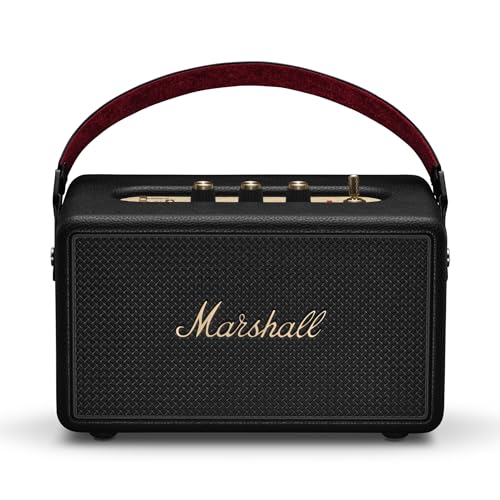
A portable Bluetooth speaker with exceptional 50+ hour battery life and a feature combination that no cheaper alternative matches. Acoustic performance cannot be independently verified from available measurement data. Significant brand premium and heritage-focused design investment limit the rationality of design philosophy score.
Overview
Marshall entered the portable consumer speaker market through Zound Industries, a Swedish audio engineering company that has designed and manufactured Marshall-branded consumer electronics since 2010 and completed full acquisition of the Marshall brand in 2023. The Kilburn III, released May 27, 2025, is the third generation of Marshall’s mid-to-large portable speaker, priced at 349.99 USD. Advances over the Kilburn II include battery life increasing from approximately 20 hours to 50+ hours, IP protection improving from IPX2 to IP54, Bluetooth 5.3 with Auracast and LC3 codec support, and the addition of USB-C power bank output. The 2.8 kg unit retains the retro amplifier-inspired aesthetic with metal control knobs, faux leather finish, and a velvet-lined carry strap, and adds app-based placement compensation DSP alongside the physical bass/treble/volume knob controls.
Scientific Validity
\[\Large \text{0.5}\]The manufacturer publishes a frequency response range of 45Hz–20kHz with no deviation tolerance stated, and a maximum SPL of 91 dB at 1 m [1]. Without a ±dB tolerance figure, the frequency response specification cannot be evaluated against deviation-based criteria. No THD or S/N ratio figures are published by the manufacturer. An independent measurement review is confirmed to exist from a third-party measurement source [2], but the data was inaccessible at evaluation time due to JavaScript-rendered page content. With no evaluable deviation measurements available from any source, scientific validity cannot be determined and a neutral score is applied.
Technology Level
\[\Large \text{0.6}\]The Kilburn III is an in-house design by Zound Industries, drawing on over a decade of accumulated Marshall portable speaker engineering know-how. Bluetooth 5.3 with Auracast (Bluetooth LE Audio broadcast) and LC3 codec support represent a genuinely current adoption for the portable speaker category at the time of the May 2025 launch. App-accessible DSP — Dynamic Loudness (volume-dependent frequency compensation based on equal-loudness principles) and Placement Compensation (boundary reinforcement EQ modes for shelf, wall, corner, and floor positioning) — provides practical user-facing functionality. The 50W tri-amplification configuration (30W woofer + 2×10W full-range) with independent driver-section gain control is implemented appropriately.
However, the core structural elements of the design — Class D amplification (mainstream in battery-powered speakers since approximately 2010), bass-reflex enclosure (standard acoustic engineering), and angled full-range driver dispersion — are well-established throughout the portable speaker industry and present no meaningful competitive distinction. Auracast is an open Bluetooth SIG standard freely implementable by any manufacturer, so its adoption confers no proprietary protection. The overall technology combination is not expected to maintain a competitive advantage window beyond approximately one to two years.
Cost-Performance
\[\Large \text{1.0}\]The Kilburn III carries a current market price of 349.99 USD. A comprehensive search across JBL, Bose, Sony, Tribit, Anker Soundcore, and W-KING found no portable Bluetooth speaker priced below 349.99 USD that simultaneously provides equivalent-or-better performance across all user-facing function axes: battery life at or above 50 hours, 3.5mm AUX input, IP54 or better weather resistance, app-based EQ, Bluetooth multipoint, Auracast, and USB-C power bank output.
The dominant disqualifiers for lower-priced alternatives were battery life and AUX input availability. The JBL Xtreme 4 (299.95 USD) provides only 24 hours of battery life and does not include a 3.5mm AUX input, failing on both axes. The JBL Charge 6 (179–250 USD) similarly offers 24-hour battery life and no 3.5mm AUX. The Tribit StormBox Blast (199 USD) reaches 30 hours of battery life but falls short of the 50-hour threshold. The Anker Soundcore Motion Boom Plus (179 USD) reaches only 20 hours. The Sony SRS-XG500, priced at approximately 339–499 USD, provides 30 hours of battery life and is a substantially larger product class at 5.6 kg and 460 mm width compared to the Kilburn III’s 2.8 kg and 273 mm. Products priced above 349.99 USD (Bose SoundLink Max at approximately 399 USD) are not cheaper alternatives.
No cheaper equivalent-or-better product was identified. The Kilburn III is the cheapest available option providing this specific combination of user-facing functions as of 2026-06-04. CP = 1.0.
Reliability & Support
\[\Large \text{0.6}\]The standard retail warranty is 1 year from purchase, below the 2-year industry benchmark; the 2-year warranty applies only to purchases made directly through marshall.com [4]. Marshall provides global manufacturer-direct support with active firmware development: at least two updates have been released since the May 2025 launch — v1.1.2 in August 2025 addressing reconnection stability and app display corrections, and v1.2.2 (current) including a security patch [3]. Authorized paid repair is available through Marshall service partners using original parts. The user-replaceable battery, accessible via a screw panel on the underside, is a meaningful long-term serviceability design choice that mitigates the lithium-ion degradation risk inherent to portable battery-powered devices. No recalls or hardware service bulletins have been identified for this product as of 2026-06-04.
Rationality of Design Philosophy
\[\Large \text{0.4}\]The Kilburn III applies modern engineering approaches throughout: Class D amplification, DSP-based loudness and placement compensation, and Bluetooth 5.3 with LE Audio are rational, efficient choices for a battery-powered portable speaker. Generational improvements from Kilburn II to Kilburn III are substantive on functional metrics — battery life increased approximately 150% (20h to 50+h), IP protection improved from IPX2 to IP54, USB-C power bank output added, and Auracast broadcast audio introduced — representing clear user-facing functional progression [1].
However, a significant portion of the product’s cost allocation is directed at non-functional elements. The heritage retro aesthetic — essentially unchanged in visual concept since the original Kilburn of approximately a decade prior — together with the velvet-lined strap, metal grille, gold-tone controls, and the overall brand premium constitute a substantial share of the 349.99 USD price point. The product’s launch price increased 80 USD versus the Kilburn II while the core acoustic approach (angled driver array, passive bass-reflex cabinet) carried over without addressing the fundamental acoustic constraints of the compact portable form factor through novel means. High-resolution wireless codec support (LDAC, aptX Adaptive) was not introduced, limiting the wireless audio ceiling to the AAC/LC3 level achievable with the previous generation. The product philosophy is fundamentally conservative: generational improvements are concentrated on battery capacity and connectivity standards, and the visual and acoustic design identity is maintained rather than renewed.
Advice
The Kilburn III is the appropriate choice for users who specifically require a portable Bluetooth speaker with 50+ hour battery life, 3.5mm AUX input, IP54 weather resistance, app-based EQ, Auracast, and USB-C power bank output within a single portable unit. No competing product at a lower price was identified that satisfies all of these requirements simultaneously as of mid-2026; the exceptional battery life is the primary functional differentiator that drives the CP=1.0 result.
Users whose primary concerns are audio measurement performance and cost efficiency, rather than extended battery life or wired AUX input, will find capable alternatives in the 150–250 USD range that cover most of the remaining functional requirements. The acoustic performance of this product cannot be independently verified from any published measurement data with evaluable figures [2]. Buyers drawn primarily by the Marshall visual identity should be aware that the heritage aesthetic and brand premium constitute a meaningful cost component relative to the functional specification. If battery life above approximately 30 hours is not a requirement, the functional and acoustic justification for the 349.99 USD price point diminishes substantially.
References
[1] Marshall - “Kilburn III Product Page” - https://www.marshall.com/us/en/product/kilburn-iii?pid=1007443 - accessed 2026-06-04
[2] RTINGS.com - “Marshall Kilburn III Review” - https://www.rtings.com/speaker/reviews/marshall/kilburn-iii - accessed 2026-06-04 (measurement confirmed; numeric data not extractable due to JavaScript rendering)
[3] Marshall - “Support for Kilburn III - Latest Firmware Version” - https://www.marshall.com/us/en/support/speakers/support-for-kilburn-iii - accessed 2026-06-04
[4] Marshall - “Warranty & Repairs” - https://www.marshall.com/us/en/support/warranty - accessed 2026-06-04
(2026.6.7)
External Search
Check additional information and availability outside this site.