
Product Review
Philips SHP9500
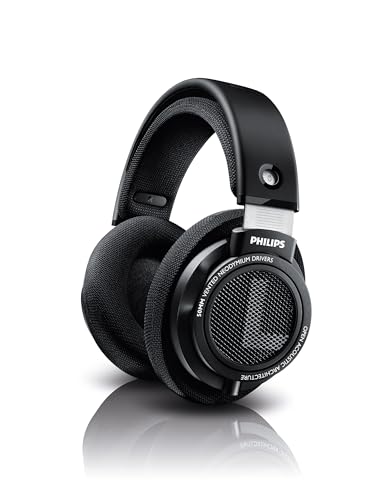
Open-back over-ear headphones with 50mm neodymium drivers targeting entry-level audiophile market through cost-effective design approach
Overview
The Philips SHP9500 are open-back over-ear headphones released in July 2019, featuring 50mm neodymium drivers with 12-35,000 Hz frequency response and 32-ohm impedance. Originally priced at 99.99 USD MSRP, currently available through third-party sellers at approximately 85 USD. The product positioned itself in the entry-level audiophile market with open-back acoustic architecture designed to eliminate air pressure build-up behind drivers.
Scientific Validity
\[\Large \text{0.5}\]Third-party measurements from RTINGS show significant frequency response roll-off below 100Hz and multiple peaks between 5-10kHz [1]. ASR Forum measurements indicate THD described as “a bit on the high side” at 92dB SPL without specific numeric values [2]. DIY-Audio-Heaven reports bass extension with slight warmth and remaining 5kHz peak [3]. While measurements exist from credible sources including Crinacle’s In-Ear Fidelity database [4], specific numeric values for key distortion metrics remain unavailable for comprehensive evaluation.
Technology Level
\[\Large \text{0.3}\]The SHP9500 employs entirely standard technologies common by 2019 release. Features 50mm neodymium dynamic drivers, conventional open-back housing architecture, and angled driver positioning for ergonomic alignment [1]. No proprietary innovations, cutting-edge technologies, or competitive advantages present. Design origin unclear with no documented in-house development or patents. Technology implementation represents cost-effective application of established industry practices rather than advancement.
Cost-Performance
\[\Large \text{1.0}\]CP = 1.0 (no cheaper equivalent-or-better product exists). Comparison: N/A. After comprehensive search across budget open-back headphones including Grado SR60x, Samson SR850, and AKG K240 Studio, no products demonstrated equivalent-or-better measured performance at lower prices [5]. Candidates showed worse THD characteristics (Grado SR60x “very high distortion” per ASR, AKG K240 Studio “massive 2nd harmonic distortion” per Sonarworks) or insufficient measurement data. This site evaluates based solely on functionality and measured performance values, without considering driver types or configurations.
Reliability & Support
\[\Large \text{0.5}\]Standard Philips warranty coverage applies with global support through phone, WhatsApp, email, and chat channels [1]. Warranty period undocumented on official pages. Limited repair services with primary focus on earpad replacement through third-party suppliers including Geekria and Dekoni Audio. Known issues include shallow earpads causing ear contact with driver housing, light clamping force creating fit problems, and cable attachment quality concerns. Global manufacturer presence provides ongoing support availability.
Rationality of Design Philosophy
\[\Large \text{0.8}\]Demonstrates highly rational cost-performance focused approach. Philips explicitly prioritized extracting maximum acoustic performance from proven technologies at low price points [1]. Cost allocation favors functional components: 50mm neodymium drivers and steel headband construction over aesthetics or brand premium. Design uses efficient mass production techniques with standard dynamic driver technology, avoiding meaningless investments in exotic materials or complex configurations. Successor SHP9600 shows logical progression with material improvements at appropriate price increase, confirming rational development strategy.
Advice
The SHP9500 represents a reasonable entry point into open-back headphones when available at current third-party pricing around 85 USD. Suitable for users seeking wide soundstage characteristics typical of open-back design with easy amplification requirements due to 32-ohm impedance and 101dB sensitivity. Consider comfort limitations from shallow earpads and light clamping force before purchase. Third-party replacement parts remain available for maintenance needs. Alternative consideration warranted if specific measured performance thresholds required, as available measurement data lacks comprehensive numeric specification for key distortion metrics.
References
[1] Philips USA Official Product Page - HiFi Stereo Headphones SHP9500/00 - https://www.usa.philips.com/c-p/SHP9500_00/hifi-stereo-headphones - accessed 2026-02-15
[2] Audio Science Review Forum Discussion - Philips SHP9500 Budget Headphones - https://www.audiosciencereview.com/forum/index.php?threads/philips-shp9500-are-the-best-budget-headphones.43191/ - accessed 2026-02-15
[3] DIY-Audio-Heaven - SHP9500 Measurements - https://diyaudioheaven.wordpress.com/headphones/measurements/brands-philips/shp9500/ - accessed 2026-02-15 - Flatbed measurement rig, no smoothing
[4] In-Ear Fidelity - Philips SHP9500 - https://crinacle.com/graphs/headphones/philips-shp9500/ - accessed 2026-02-15
[5] RTINGS - Philips SHP9500 Review - https://www.rtings.com/headphones/reviews/philips/shp9500 - accessed 2026-02-15 - Standard RTINGS methodology
(2026.2.16)
External Search
Check additional information and availability outside this site.