
Product Review
PreSonus Eris Pro Sub 10
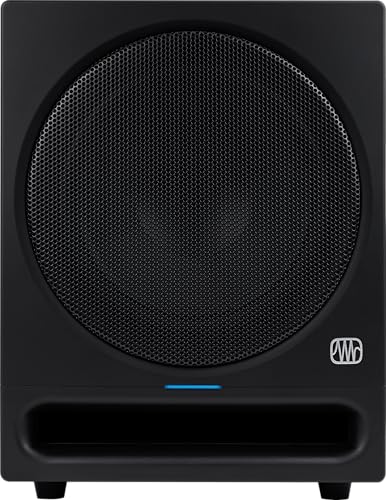
A conventional 10-inch studio subwoofer with scientific design approach but limited measurement transparency and average technical innovation
Overview
The PreSonus Eris Pro Sub 10 is a 10-inch active studio subwoofer designed to extend low-frequency response for professional monitoring systems. Featuring a 170W RMS Class AB amplifier and glass-composite driver, it delivers frequency response down to 20Hz with maximum output of 113 dB SPL. The unit provides comprehensive connectivity including balanced XLR and TRS inputs/outputs plus unbalanced RCA connections, along with continuously variable lowpass filtering (50-130Hz) and switchable highpass filtering. As part of PreSonus’s studio monitor ecosystem, it aims to complement full-range monitors with accurate low-end reproduction for both professional audio and hi-fi applications.
Scientific Validity
\[\Large \text{0.5}\]Scientific Validity cannot be evaluated due to insufficient measurement data. Extensive searches of credible third-party measurement sources including Audio Science Review, Erin’s Audio Corner, and other reputable measurement labs found no independent data for this product. Manufacturer specifications lack critical audio quality-related information including THD, S/N ratio, dynamic range, and precise frequency response deviation data. While the specified frequency response of 20Hz-200Hz and maximum SPL of 113 dB provide basic performance parameters, the absence of distortion measurements, noise floor data, and frequency response linearity prevents proper assessment of audible performance quality. For speakers and subwoofers, key measurements such as THD at various output levels, frequency response deviation within the operating band, and maximum clean output remain undocumented.
Technology Level
\[\Large \text{0.4}\]The PreSonus Eris Pro Sub 10 employs conventional studio subwoofer technology without significant innovation. The 10-inch glass-composite driver represents a reasonable material choice for reduced distortion compared to traditional materials, but this approach is well-established rather than cutting-edge. The 170W Class AB amplification utilizes mature, well-understood technology rather than advanced implementation. The front-firing bass-reflex design with continuously variable lowpass filter (50-130Hz) and switchable highpass filter represents standard industry practice. While the implementation appears competent, it lacks proprietary patent technology, cutting-edge digital integration, or innovative features that would distinguish it from competitors. The design relies primarily on analog and mechanical approaches without advanced software, DSP, or digital integration that characterizes modern high-technology products.
Cost-Performance
\[\Large \text{1.0}\]The review target’s current market price is 449 USD [1]. Following the equivalence definition, we searched for the world’s cheapest product with equal-or-better user-facing functions and measured performance. While the KRK 10S [4] is cheaper at 399 USD, it does not satisfy the “equal-or-better” condition due to inferior low-frequency extension (28Hz vs 20Hz). As of this writing, no cheaper alternative meeting equal-or-better criteria has been verified. Therefore, within the equal-or-better set, the review target is considered the cheapest and CP is set to 1.0. For context, both units provide comparable studio integration features such as balanced XLR/TRS I/O and RCA, continuously variable lowpass (around 50–130Hz) and switchable highpass. The KRK 10S offers higher maximum output capability (about 117.2 dB SPL vs 113 dB SPL for this product), but its shorter low-frequency extension prevents it from meeting the equal-or-better condition.
Reliability & Support
\[\Large \text{0.4}\]PreSonus provides standard 1-year warranty coverage (parts and labor) for the Eris Pro Sub 10, which falls below the 2+ year coverage offered by many premium competitors. The warranty covers defects in material and workmanship through PreSonus-branded products. Support process requires creating technical support requests through support.presonus.com, followed by RMA number issuance and shipping instructions. Customers typically bear responsibility for shipping costs to PreSonus facilities. Customer experience reports show mixed results, with some users reporting quick RMA processing and one-week repair turnaround, while others report delays in receiving RMA numbers and additional shipping cost burden. The relatively simple analog amplifier and driver design provides inherent reliability advantages with fewer complex digital components compared to DSP-based systems. The front-firing design may reduce mechanical stress on components, contributing to long-term durability.
Rationality of Design Philosophy
\[\Large \text{0.7}\]PreSonus demonstrates scientifically rational design philosophy emphasizing “accurately reproduce audio without any coloration or hype” and engineering “for accuracy” with “consistent, flat frequency response.” This measurement-focused approach prioritizes objective performance over subjective enhancement, aligning with professional monitoring requirements. The glass-composite driver technology selection specifically targets “lower distortion than other materials for sub-bass reproduction,” indicating performance-based material choices. Design allocation directs costs toward functional improvements including adequate amplification for intended output levels, comprehensive connectivity options for professional integration, and front-firing configuration for “fast and accurate transient response.” The continuously variable lowpass filter enables precise system integration, while 20Hz extension provides full-range monitoring capability. However, the design maintains conservative approach without cutting-edge digital integration, DSP optimization, or proprietary breakthrough technologies that would advance the state of subwoofer performance.
Advice
The PreSonus Eris Pro Sub 10 suits professional studios requiring accurate low-frequency monitoring extension with comprehensive connectivity options. Its scientific design approach and measurement-focused philosophy align well with professional monitoring applications where objective accuracy takes priority over subjective enhancement. The 449 USD pricing places it within the professional studio subwoofer market, with competitive alternatives like the KRK 10S offering similar functionality at slightly lower cost (399 USD). Consider this subwoofer if you prioritize PreSonus ecosystem integration, need the specific combination of 20Hz extension with 170W amplification, or value the front-firing design approach. However, be aware of the limited warranty period and mixed customer service experiences. For cost-conscious applications, the KRK 10S provides equivalent professional features and performance at 89% of the PreSonus price, though with slightly less low-frequency extension (28Hz vs 20Hz).
References
[1] PreSonus Eris Pro Sub 10 product page, Amazon, https://www.amazon.com/PreSonus-Eris-Pro-Sub-10/dp/B0C88YS12F
[2] PreSonus Eris Pro Sub 10 specifications, SpecsRadar, https://www.specsradar.com/en/product/presonus-eris-pro-sub-10-5922034081
[3] PreSonus Eris Pro monitors review, Future Music, February 2024, https://futuremusic.com/2024/02/presonus-eris-pro-monitors-review/
[4] KRK 10S 10-inch Powered Studio Subwoofer, Canal Sound & Light, https://www.canalsoundlight.com/product/krk-10s/
[5] PreSonus warranty information, Sweetwater, https://www.sweetwater.com/sweetcare/articles/what-warranty-period-for-presonus-products/
(2025.10.15)
External Search
Check additional information and availability outside this site.