
Product Review
RODE RODE NT1 Signature
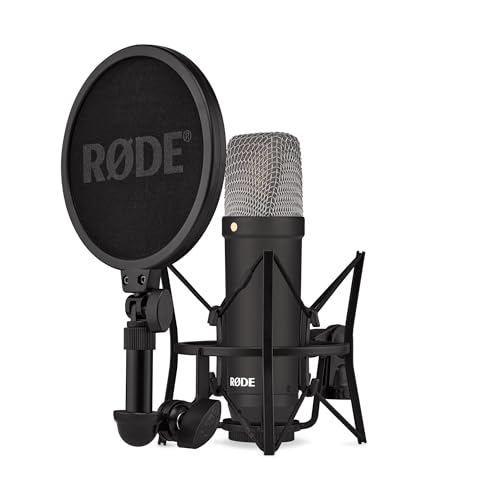
Large-diaphragm XLR condenser microphone with manufacturer-claimed 4 dB-A self-noise at 159 USD. No less expensive equivalent-or-better alternative identified; 10-year warranty and in-house Sydney manufacturing distinguish it in the segment. All performance figures are manufacturer-published with no independent third-party verification available.
Overview
The RØDE NT1 Signature Series, released in November 2023, is a large-diaphragm cardioid condenser microphone priced at 159 USD [1]. Manufactured at RØDE’s Sydney, Australia facility using the proprietary HF6 capsule, the NT1 Signature shares its core analog circuit platform with the simultaneously released NT1 5th Generation while omitting that model’s USB-C output, onboard APHEX DSP processing, and 32-bit float recording to reach a lower price point. The package includes the SM6 shockmount, RP1 pop filter, and a premium XLR cable. Nine color variants are offered.
Scientific Validity
\[\Large \text{0.7}\]Manufacturer specifications [1][2] report an Equivalent Noise Level (EIN) of 4 dB-A (IEC651, A-weighted), among the lowest published self-noise figures for any studio condenser microphone. The S/N ratio is rated at 90 dB (A-weighted, referenced to 94 dB SPL), indicating excellent noise performance. Maximum SPL is specified at 137 dB SPL (1 kHz, 1% THD per IEC standard conditions), well within acceptable limits for studio recording. Frequency response is specified as 20 Hz to 20 kHz, with a presence peak in the upper frequencies visible in the manufacturer’s on-axis graph [2].
No independent third-party measurements from credible laboratory sources are available for this product as of the review date. All performance figures are manufacturer-published and unverified by independent testing. The score reflects this limitation in data availability.
Technology Level
\[\Large \text{0.7}\]RØDE designs and manufactures the NT1 Signature entirely in-house at its Sydney facility [1]. The proprietary HF6 capsule uses a single-sided 1-inch gold-sputtered diaphragm mounted on a tabbed backplate machined to sub-micron CNC tolerances — a manufacturing approach that has sustained RØDE’s price-performance positioning in the large-diaphragm condenser segment for over a decade. This depth of accumulated capsule manufacturing know-how constitutes a competitive moat that requires substantial capital and years of development for new entrants to replicate.
Against these strengths, the HF6 capsule and tabbed backplate design trace to approximately 2012–2013, placing the core capsule technology in the mature category at the 2023 launch. No active patents were identified specifically for the NT1 Signature. The product is an entirely analog, phantom-powered FET circuit with no digital integration — no software layer, no connectivity architecture, no DSP of any kind. This analog-only implementation constrains the technology level assessment. Net: strong manufacturing pedigree with an absence of digital advancement.
Cost-Performance
\[\Large \text{1.0}\]The NT1 Signature at 159 USD is the world’s least expensive large-diaphragm cardioid condenser microphone with an EIN of 4.2 dB-A or below, S/N ratio of 85.5 dB or above, and Maximum SPL of 130 dB or above. No product satisfying these combined performance criteria is available at a lower market price.
The RØDE NT1 5th Generation [3][5], available at 185 USD (Thomann US), was identified as the nearest equivalent-or-better option: it matches the NT1 Signature’s EIN (4 dB-A), S/N ratio (~90 dB), and frequency response (20–20,000 Hz), while exceeding its Maximum SPL (142 dB vs 137 dB) and providing a superset of user-facing functions including USB-C output, onboard APHEX DSP, and 32-bit float recording. All other candidates evaluated below 159 USD were disqualified due to substantially inferior EIN (NT1-A: 5 dB-A; sE X1 S: 9 dB-A; Lewitt LCT 440 PURE: 7 dB-A; Sennheiser MK 4: 10 dB-A). Since the cheapest equivalent-or-better product is priced above the NT1 Signature, CP = 1.0.
This result is provisional — all performance data used in the comparison are manufacturer-published specifications, as no independent third-party measurements are available for any product evaluated.
Reliability & Support
\[\Large \text{1.0}\]The NT1 Signature carries a 10-year manufacturer warranty upon product registration [1], far exceeding the standard 2-year industry period. The design is a fully analog machined aluminum construction with no moving parts, no batteries, and no digital circuitry, representing an inherently simple and robust architecture with minimal failure vectors. RØDE provides direct manufacturer support globally through its Sydney headquarters, a US service center, and an authorized dealer network worldwide, with warranty management handled via RØDE’s online portal. The NT1 product family has been in continuous production since 1991, and no documented reliability issues, recalls, or service bulletins have been identified for the Signature model [1].
Rationality of Design Philosophy
\[\Large \text{0.8}\]The NT1 Signature’s design philosophy is grounded in standard, measurable performance metrics. All published performance claims are expressed in established measurement units with no unverifiable assertions [1]. Cost allocation is directed toward the performance-critical elements — HF6 capsule precision and improved analog circuitry — that directly produced the 4 dB-A EIN and elevated SPL ceiling rather than toward non-functional elements. Generation-over-generation improvements are consistent and numerically verifiable: NT1-A (5 dB-A, ~130 dB SPL) → 4th Generation (4.5 dB-A, 132 dB SPL) → Signature (4 dB-A, 142 dB SPL). The decision to remove USB and DSP from the 5th Generation platform to produce the Signature at a lower price represents active cost optimization for the XLR-only use case.
A dedicated XLR condenser requiring 48V phantom power represents fully justified specialized audio equipment. The one constraining factor is that the NT1 Signature is primarily a product-line configuration variant — the 5th Generation’s analog circuit with USB and DSP removed — rather than a novel engineering initiative addressing a new performance frontier. The color variants constitute marketing differentiation without acoustic consequence.
Advice
The NT1 Signature suits studio vocal recording, podcasting, voice-over, and acoustic instrument work where an XLR audio interface is already in place. With a manufacturer-claimed EIN of 4 dB-A, no less expensive large-diaphragm cardioid condenser meeting equivalent self-noise criteria was identified in the comparison analysis at 159 USD [4]. The 10-year warranty substantially reduces long-term ownership risk relative to most competitors in this category. Users requiring USB direct-to-computer recording, onboard compression, noise gating, or 32-bit float capability should consider the RØDE NT1 5th Generation [3], which delivers equivalent analog performance for approximately 185 USD (Thomann US) [5] or approximately 249 USD at US direct retail, with those additional functions included. All performance specifications cited are manufacturer-published; independent laboratory verification is not yet available and should be factored into a final purchase decision.
References
[1] RØDE Microphones - NT1 Signature Series - https://rode.com/en-us/products/nt1-signature-series - accessed 2026-05-26 [2] RØDE Microphones - NT1 Signature Series Datasheet (PDF) - https://edge.rode.com/pdf/products/1362/NT1%20Signature%20Series_Datasheet_FA.pdf - accessed 2026-05-26 [3] RØDE Microphones - NT1 5th Generation - https://rode.com/en-us/products/nt1-5th-generation - accessed 2026-05-26 [4] Thomann - Rode NT1 Signature Black - https://www.thomannmusic.com/rode_nt1_signature_black.htm - accessed 2026-05-26 [5] Thomann - Rode NT1 5th Generation Black - https://www.thomannmusic.com/rode_nt1_5th_generation_black.htm - accessed 2026-05-26
(2026.5.27)
External Search
Check additional information and availability outside this site.