
Product Review
Softears RS10
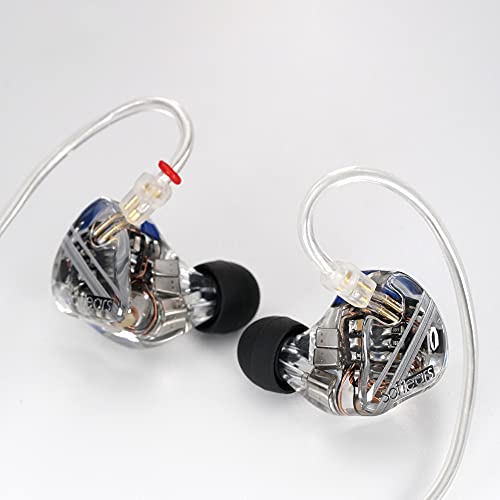
The Softears RS10 is a 10-driver all-balanced-armature flagship IEM with excellent measured distortion performance and neutral frequency response confirmed by independent data. No cheaper verified equivalent was found, yielding CP=1.0. The all-passive analog architecture is now mature relative to current standards, and the product is approaching end-of-life.
Overview
The Softears RS10 is the flagship of Softears’ “Reference Sound” series — a 10-driver all-balanced-armature universal IEM first announced in China around 2018 and introduced internationally in 2021. Softears, founded in 2017 in Chengdu, operates its own R&D laboratory and manufacturing facility. At 2,099 USD, the RS10 targets professional reference monitoring with a VDSF-tuned frequency response. As of 2026, the product is sold out at the official store and most authorized retailers, indicating an approaching end-of-life.
Scientific Validity
\[\Large \text{0.8}\]Independent measurements show THD below 0.04% at 90 dB SPL, measured up to the 9th harmonic [2] — a distortion figure well below typical balanced armature performance. Frequency response deviation is within ±1 dB from 200 Hz upward against a diffuse-field target, with the worst-case deviation reaching approximately 2.5 dB at 4 kHz [2]. These frequency response findings are corroborated by measurements from additional reviewers comparing against the IEF Neutral and VDSF targets respectively [3][4], all confirming broadly neutral, high-compliance tuning. Manufacturer-specified THD below 1% and IMD below 1% are conservative maximum limits without stated test conditions [1]; the third-party distortion figure substantially exceeds these. S/N ratio, IMD, and sound isolation lack published third-party numeric measurements. The two quantifiable primary metrics — THD and frequency response deviation — both demonstrate low distortion and tight frequency response control. A conservative score adjustment is applied because the distortion measurement originates from an individual reviewer rather than a dedicated measurement laboratory [2].
Technology Level
\[\Large \text{0.4}\]The RS10’s central engineering achievements are a 5-way passive crossover incorporating a 4th-order LC bandpass filter with 15 components consolidated into two modules, custom-commissioned D-MID-B midrange balanced armature drivers, and a flat impedance design that minimizes frequency response variation across source output impedances. These combine to produce the measured THD below 0.04% [2], which the measuring reviewer describes as unusually low for the balanced armature format. An additional passive diaphragm element provides mechanical pressure relief within the shell. The engineering represents documented in-house design work.
Evaluated against 2026 standards, the all-BA passive crossover approach is a well-established technology. Current development in the IEM segment is defined by tribrid configurations combining dynamic, balanced armature, and electrostatic drivers alongside DSP-corrected designs with digital crossovers. The RS10 is entirely passive and analog with no digital processing, no wireless capability, and no app integration. No patents are publicly documented. The product has no documented successor, indicating stagnant development in this line. The included cable carries a silver-plated single-crystal copper specification without confirmed acoustic benefit.
Cost-Performance
\[\Large \text{1.0}\]An exhaustive search covering 13 candidates ranging from 17 USD to 1,499 USD — 10 wired IEMs and 3 wireless TWS earbuds excluded on functional grounds as a different product category — found no wired passive IEM with confirmed third-party numeric THD at or below approximately 0.042% and frequency response deviation at or below approximately ±1 dB from a neutral target at a price below 2,099 USD. Because the RS10 has a published third-party THD value, candidates without independently measured distortion data were excluded from consideration. No qualified cheaper alternative was identified.
CP = 1.0 (no cheaper equivalent-or-better product exists)
Reliability & Support
\[\Large \text{0.5}\]Warranty duration is not stated on the official Softears store; authorized retailers cite 1 year or 2 years depending on the retailer, leaving effective coverage ambiguous [1]. International warranty claims require physical return of the unit to China, as no regional service centers are documented. The cable is user-replaceable via the standard 0.78mm 2-pin connector, and compatible aftermarket cables are widely available. The internal driver assembly is not user-serviceable. No widespread hardware failures, driver defects, or recall notices have been identified across available review and community sources [4]. As a relatively young boutique manufacturer, long-term reliability data remains limited. The product’s current sold-out status across most retail channels raises mild concerns about future parts and service availability.
Rationality of Design Philosophy
\[\Large \text{0.7}\]The RS10’s stated tuning target — VDSF, a variant of the EN ISO 11904-2 diffuse-field reference — is objectively verifiable, and independent FR measurements confirm adherence to within ±1 dB from 200 Hz upward [2]. Engineering investment in the custom-commissioned drivers and 15-component passive crossover network is directly traceable to the confirmed THD below 0.04% [2]. The in-house proprietary crossover design and custom driver specification represent technology choices that serve the measured performance goal.
Two deductions apply. The included cable is presented as a quality feature based on its conductor specification, but cable material choices at typical IEM resistance values have no independently verified audible effect. The passive pressure-relief element is described as reducing listening fatigue, a benefit that has not been verified through controlled measurement. Both represent asserted audible benefits for elements whose audibility is not established.
Advice
The RS10 delivers confirmed low measured distortion and tightly controlled neutral frequency response, verified by independent third-party data. The CP score of 1.0 reflects that no cheaper product with confirmed equivalent performance was identified, making it the most affordable verified option at its measured performance level among wired passive IEMs.
Several practical considerations are significant for purchasing decisions. The product is sold out at most retailers and appears to be entering end-of-life; confirming in-stock availability and verifying the seller’s warranty terms before purchasing is essential, as official warranty duration is ambiguous. At 2,099 USD, the all-passive BA architecture represents a mature rather than current-generation approach; buyers seeking DSP-corrected designs or tribrid configurations should evaluate newer alternatives. The large shell size is reported to cause fit difficulties for users with smaller ears — confirming physical fit through a demo or during a return-eligible purchase window is advisable before committing at this price.
References
[1] Softears Official Store — RS10 Product Page — https://softears.store/products/softears-rs10 — accessed 2026-05-29
[2] Klaus Eulenbach — “Softears RS10: Reference Sound Has a Number” — https://www.klauseulenbach.de/2021/04/16/softears-rs10/ — accessed 2026-05-29; THD measured at 90 dB SPL up to 9th harmonic; FR measured against EN ISO 11904-2 DF target
[3] Crinacle / In-Ear Fidelity — Softears RS10 frequency response database — https://crinacle.com/graphs/iems/softears-rs10/ — accessed 2026-05-29; FR measured against IEF Neutral target
[4] Headfonics — Softears RS10 Review — https://headfonics.com/softears-rs10-review/ — accessed 2026-05-29
(2026.5.31)
External Search
Check additional information and availability outside this site.