
Product Review
Softears Studio4
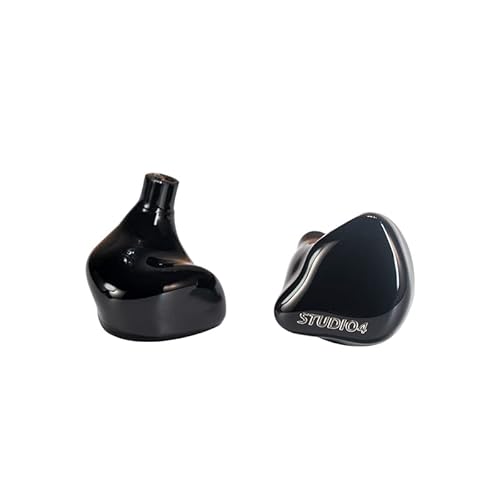
The Softears Studio4 is a 449 USD wired four-driver balanced armature IEM targeting professional studio monitoring, with good Harman target compliance (1.76 dB deviation) and controlled distortion confirmed by third-party measurements. All technologies are mature with no proprietary innovations, and substantially equivalent measured performance is available at a fraction of the price.
Overview
The Softears Studio4 is the entry point to Softears’ professional Studio Series, priced at 449 USD. Targeting studio recording engineers and stage performers, it uses four balanced armature drivers with a 3-way passive crossover housed in 3D-printed medical-grade resin shells. Connection is via 3.5mm single-ended with a detachable 0.78mm 2-pin cable. Softears, founded in 2017 and based in Chengdu, shares R&D resources with Moondrop.
Scientific Validity
\[\Large \text{0.6}\]The manufacturer specifies frequency response of 20Hz–20kHz (IEC60318-4) and THD less than 1% at 1kHz. Third-party measurements [2] confirm THD remains within 1% across test levels spanning 86 to 104 dB SPL, with second-harmonic distortion assessed as excellent and overall distortion characterized as controlled throughout. Frequency response deviation from the Harman IEM target measures 1.76 dB, placing the Studio4 in the good range — above average compliance but short of excellent. The tuning follows the Harman 2018 target closely through 5 kHz, with some attenuation in the upper treble region. Multiple independent review sources consistently describe passive noise isolation as exceptional, at a level associated with active noise-cancelling products, though no specific dB figure has been published for this product. S/N ratio is not applicable to this fully passive transducer. Frequency response is well-controlled and distortion is confirmed within the manufacturer’s upper bound by third-party measurement, but the absence of precise numeric documentation across all relevant metrics prevents a higher score.
Technology Level
\[\Large \text{0.2}\]Every core technology in the Studio4 was firmly established well before its Spring 2023 release. Multi-balanced-armature IEM configurations have been industry-standard since the mid-2000s; 3-way passive crossovers in IEMs date to at least 2007–2008; 3D-printed resin shells became common in the IEM market from approximately 2018. No proprietary patents have been identified for Softears or this product. Design origin is partially in-house — Softears operates a dedicated R&D facility in Chengdu — but shares development resources with Moondrop, and the origin of the balanced armature drivers (custom-specified standard units versus fully in-house fabricated) is unconfirmed. The product is entirely analog and passive: no digital signal processing, no software control, no wireless connectivity, no active components beyond the analog 3.5mm interface. Competing manufacturers can produce equivalent multi-driver balanced armature IEMs with comparable crossover tuning without significant additional engineering effort. These factors collectively yield a score well below the midpoint.
Cost-Performance
\[\Large \text{0.0}\]This site evaluates based solely on functionality and measured performance values, without considering driver types or configurations.
The Studio4 is a wired passive IEM with 3.5mm single-ended connectivity, a detachable 0.78mm 2-pin cable interface, and compatibility with any standard analog source — with no DSP, wireless functionality, or active processing.
The 7Hz Salnotes Zero, available at 20.99 USD [4], provides equivalent or better user-facing functionality and measured performance. Both products are wired passive IEMs with 3.5mm connectivity and detachable 0.78mm 2-pin cable systems, fully compatible with any analog source. Performance comparison based on third-party measurements [2][3]: frequency response deviation from the Harman IEM target is 1.31 dB for the Salnotes Zero versus 1.76 dB for the Studio4 — the Salnotes Zero demonstrates superior Harman compliance. THD for the Salnotes Zero is assessed by third-party measurement [3] as “impressively low,” equivalent to or better than the Studio4’s confirmed “within 1% across all tested SPL levels” [2]. Passive isolation data with a published numeric dB value is unavailable for either product.
CP = 20.99 USD / 449 USD = 0.0468
Rounded to the first decimal place: 0.0.
Reliability & Support
\[\Large \text{0.4}\]The Studio4 carries a 1-year warranty on the IEM unit, with 3 months on the included cable — below the industry average of 2 years. Support is delivered through authorized distributors including Linsoul, HiFiGo, and MusicTeck, rather than through a direct manufacturer consumer support infrastructure. The core IEM design is mechanically simple: a fully sealed balanced armature assembly in a 3D-printed resin shell with a detachable cable, no active electronics, no battery, and no moving parts beyond the cable connector — a structure inherently resistant to many common failure modes. However, multiple independent professional reviews have documented a structural design flaw: the nozzle lacks a retaining lip, causing wide-bore ear tips to slide off during use. This is a confirmed, recurring issue affecting compatibility with a range of aftermarket tip options, not an isolated report. No statistical failure rate data is publicly available, and no recalls or systematic defect notices have been issued.
Rationality of Design Philosophy
\[\Large \text{0.6}\]Softears explicitly targets flat, neutral frequency response tuning for professional monitoring — a scientifically grounded design objective. Third-party measurements [2] confirm the frequency response closely follows the Harman 2018 target through 5 kHz, validating this measurement-focused claim. Cost allocation is directed primarily toward acoustic performance: four balanced armature drivers and crossover development represent the principal expenditure, with minimal investment in non-functional aesthetics or branding premiums. These factors reflect a function-first, measurement-informed approach.
However, the Studio4’s architecture is entirely conventional for 2023. An all-passive, all-BA IEM with standard connector and standard passive crossover represents the most traditional professional IEM implementation available, with no adaptive processing, DSP, software capability, or novel acoustic architecture. Some manufacturer claims — including consistent phase response and exceptional passive isolation — have not been verified by independent numeric measurements. The THD specification of less than 1% is an unusually loose upper bound for a balanced armature product, providing minimal diagnostic value regarding actual distortion performance. Model evolution from the RSV represents downward scaling rather than measurable technical advancement, and no Studio4 successor with documented performance improvements has appeared.
Advice
The Studio4 is suited to users specifically requiring a compact, passive multi-BA professional IEM with documented Harman-adjacent frequency response for stage or studio monitoring applications. The wired-only passive design ensures compatibility with any analog source — including professional mixing consoles and portable DAPs — without reliance on batteries or software.
Prospective buyers should be aware of several significant limitations. The 7Hz Salnotes Zero at 20.99 USD achieves superior frequency response Harman compliance (1.31 dB versus 1.76 dB deviation [2][3]) and equivalent or better distortion performance, making the 449 USD Studio4 difficult to justify on measured performance grounds alone. The nozzle’s documented absence of a retaining lip restricts ear tip options, particularly for users who prefer wide-bore aftermarket tips. No EQ, DSP, or tuning adjustments are available; the frequency response is fixed. Those who specifically require the Studio4’s physical profile, stage isolation characteristics, or professional IEM form factor may find it serviceable for the intended use case, but buyers optimizing for measured performance per dollar should direct their attention elsewhere.
References
[1] Softears — Studio4 Official Store Page — https://softears.store/products/softears-studio4 — accessed 2026-05-29
[2] Audio Science Review — Softears Studio 4 Review — https://www.audiosciencereview.com/forum/index.php?threads/softears-studio-4-review.43076/ — posted March 2023; accessed 2026-05-29; test conditions: IEC711-compatible coupler, 86/96/104 dB SPL test levels
[3] Audio Science Review — 7Hz Salnotes Zero IEM Review — https://www.audiosciencereview.com/forum/index.php?threads/7hz-salnotes-zero-iem-review.50226/ — accessed 2026-05-29; test conditions: calibrated IEC711 coupler
[4] Linsoul Audio — 7Hz Salnotes Zero — https://www.linsoul.com/products/7hz-salnotes-zero — price 20.99 USD (no microphone variant); accessed 2026-05-29
(2026.5.31)
External Search
Check additional information and availability outside this site.