
Product Review
Softears Volume S
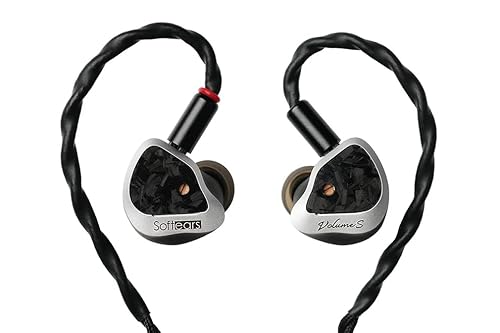
A hybrid IEM with genuine engineering depth and dual-tuning functionality, but priced at a significant premium over alternatives with equivalent or better measured performance.
Overview
The Softears Volume S is a quad-driver hybrid in-ear monitor released in December 2024, succeeding the original Volume. Softears, founded in 2019 and headquartered in Chengdu, China, operates its own acoustic R&D facility. The Volume S combines one 10mm active dynamic driver, one 6mm passive dynamic driver acting as a resonance-absorbing radiator, and two balanced armature units, with an 8-component RC crossover network carried over from the flagship RS10 and a physical impedance switch selecting between Classical (Lo-Z, 9.8Ω, 124 dB/Vrms) and Pop (Hi-Z, 31.2Ω, 114 dB/Vrms) tuning modes [1].
Scientific Validity
\[\Large \text{0.6}\]Third-party frequency response measurements from squig.link [2] confirm that the Volume S in Lo-Z (Classical) mode achieves a Harman/JM-1-adjacent tonal balance with moderate bass lift and smooth treble. Graph-based analysis across multiple tip configurations places the FR deviation from the Harman target in the standard range, approximately 2.0–2.5 dB — no numeric STD figure has been published for this product. The Hi-Z (Pop) mode measurably shifts the response toward a brighter, treble-elevated character. The manufacturer specifies THD at less than 1% at 1kHz [1]; this is a rated-output ceiling under manufacturer-defined conditions and does not characterize distortion performance at typical listening levels. No independent third-party numeric THD measurement exists. As a fully passive transducer with no internal electronics, S/N ratio, SINAD, IMD, crosstalk, and dynamic range are not applicable metrics. No credible third-party passive isolation measurement was found.
Technology Level
\[\Large \text{0.8}\]The Volume S demonstrates genuine in-house engineering with multiple substantiated design contributions. A pressure-release acoustic chamber is protected by Chinese patent CN 215420702 U. Composite balanced armature drivers (ED + WBFK configuration) are claimed as self-developed. The 8-component RC crossover is a proprietary implementation transplanted from the RS10 flagship, designed to achieve even impedance distribution across frequency. Softears operates its own R&D and manufacturing facility, accumulating meaningful technical expertise across acoustic engineering, crossover circuit design, and ergonomic shell development through collaboration with HeyGears’ ear-contour dataset platform [1]. These elements support assessments of substantive design ownership, active patent activity, and genuine technical know-how accumulation.
No individual technology is cutting-edge by current standards: passive radiators in IEMs are an established technique, RC crossovers are standard electrical engineering, impedance-switchable tuning modes exist across multiple competing products, and 3D-printed IEM shells derived from ear-scan datasets are common in the custom IEM market. The fast-moving Chinese IEM landscape places competitive advantage duration at average — this configuration can be replicated within one to two years. Technology integration is appropriate for a passive analog device; the RC circuit network prevents a purely analog-mechanical classification, though no digital or software integration applies. Overall, the documented patent activity, in-house design ownership, and accumulated acoustic know-how justify a high technology-level assessment, while the absence of clearly cutting-edge integration prevents a top-tier rating.
Cost-Performance
\[\Large \text{0.2}\]This site evaluates based solely on functionality and measured performance values, without considering driver types or configurations.
The Softears Volume S is priced at 319 USD [1]. The Kefine Klean, available at 49 USD [3], provides equivalent wired IEM connectivity: 3.5mm single-ended output, 2-pin 0.78mm detachable cable, and dual FR adjustment via interchangeable nozzles. Adding a 4.4mm balanced IEM cable (~10 USD) closes the functional gap with the Volume S’s included modular balanced plug, yielding a total comparator cost of 59 USD.
Performance comparison (provisional):
- Frequency response deviation from Harman target: Kefine Klean 1.53 dB STD (squig.link aggregate across five contributor databases, Harman 2019 target tuning confirmed by multiple contributors) [4] vs. Volume S approximately 2.0–2.5 dB STD (graph-based estimate from squig.link FR measurements [2]; no published numeric STD for the Volume S) — Kefine Klean is provisionally equivalent-or-better.
- THD: Both products lack independent third-party numeric measurements; this comparison is symmetric and provisional on this metric.
CP = 59 USD (49 USD + 10 USD cable) / 319 USD = 0.185 → 0.2 (PROVISIONAL)
This result is provisional pending publication of independent numeric FR deviation measurements for the Softears Volume S.
Reliability & Support
\[\Large \text{0.3}\]The standard warranty is 1 year on the IEM body, consistent across Softears-authorized retailers, which falls below the 2-year industry average. The included cable carries a 3-month warranty. After-sales service operates entirely through authorized retailers — Linsoul, Shenzhenaudio, Headphones.com, and others — with no direct manufacturer support portal. This retailer-mediated model provides accessible global service contacts but does not constitute a manufacturer-operated support infrastructure.
Several documented build concerns affect the long-term reliability picture. The Japanese Copal impedance tuning switch requires careful directional operation using the included tool, bears no mode indicator markings on the product body, and has been reported by multiple reviewers to sustain mechanical damage under incorrect use. Faceplate separation from the shell body is also documented among user reports. The stock paracord cable generates noticeable microphonic noise from clothing contact, though the detachable connector system allows cable replacement. No statistical failure rate data exists for this product. The short warranty and documented structural fragility support a below-average reliability and support assessment.
Rationality of Design Philosophy
\[\Large \text{0.5}\]The Volume S combines legitimate engineering choices with subjective-oriented marketing positioning. On the rational side: the RC crossover is a sound approach to frequency division and impedance linearization; the patented pressure-release chamber serves an acoustically motivated function; the HeyGears shell applies data-driven ear-contour fitting; and the bus-impedance dual-tuning provides measurably distinct and genuinely functional tonal modes without pseudoscientific premises.
On the less rational side: manufacturer communications center on subjective descriptors without published FR deviation targets or ABX-backed performance data. Technical claims including “ultra-low loss crossover” and “phase-coherent driver array” remain unverified by independent measurement. A substantial fraction of the 319 USD cost allocation goes to aesthetic elements — 5-axis CNC-machined aluminum faceplates and forged carbon fiber inlays — that carry no acoustic function. The transition from the original Volume to the Volume S materially increases the price, adding a passive radiator, tuning switch, and ergonomic redesign, but independently measured performance improvement relative to that cost increase remains unverified. The result is a balanced rationality assessment rather than a clearly positive or negative one.
Advice
The Softears Volume S demonstrates real engineering investment: a patented acoustic architecture, in-house crossover development, and a dual-tuning switch that provides measurably distinct and practically useful tonal options. Third-party FR graph data supports a Harman-adjacent tuning in Lo-Z mode.
However, the cost-performance ratio is poor by measured performance criteria. Wired IEMs with independently measured, equivalently tuned frequency response are available at a fraction of this product’s price. Documented build fragility concerns — particularly the tuning switch sensitivity and reported faceplate adhesion failures — further compound the value question at 319 USD. Prospective buyers who specifically value the dual-tuning functionality and the documented in-house engineering credentials may find justification for the premium. Those prioritizing measured acoustic performance per dollar should evaluate alternatives at substantially lower price points.
References
[1] Headphones.com - Softears Volume S In-Ear Headphones - https://headphones.com/products/softears-volumes-in-ear-headphones - accessed 2026-05-27
[2] sai.squig.link - Softears Volume S FR measurements (multiple tips, both impedance modes) - https://sai.squig.link/?share=Harman_OE_2018Linear_Target%2CSoftears_VolumeS%28black_tip%29%2CSoftears_VolumeS_%28black_tip_high_impedance_mode%29%2CSoftears_VolumeS_%28CP145%29%2CSoftears_VolumeS_%28ABP-T_tip%29 - accessed 2026-05-27
[3] HiFiGo - KEFINE Klean 10mm DLC Diaphragm Dynamic Driver IEM - https://hifigo.com/products/kefine-klean - accessed 2026-05-27
[4] Aftersound / squig.link - Kefine Klean FR measurements (Black and Silver nozzle) - https://aftersound.squig.link/?share=KEFINE_KLEAN_BLACK,KEFINE_KLEAN_SILVER,KZ_EDC_PRO - accessed 2026-05-27 - FR deviation from Harman 2019 target: 1.53 dB STD (squig.link aggregate across five contributor databases)
(2026.5.31)
External Search
Check additional information and availability outside this site.