
Product Review
Tannoy Gold 7
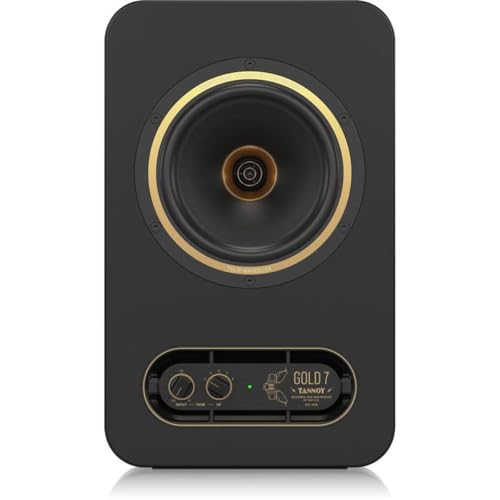
Bi-amplified 6.5-inch studio monitor featuring Tannoy's proprietary dual concentric driver technology with point-source design, facing significant cost-performance challenges at current market pricing despite offering unique dual concentric advantages for specialized applications
Overview
The Tannoy Gold 7 is a 6.5-inch powered studio monitor featuring Tannoy’s legendary dual concentric driver technology that provides class-leading phase coherence and point-source imaging. The tweeter is positioned in the centre of the bass driver, aligned with the bass driver’s voice coil, allowing for precise time alignment. With 300-watt bi-amplified design and Class-AB amplification for both low and high frequency drivers, the Gold 7 delivers superior stereo imaging and detailed sound stage with a forgiving sweetspot. The monitors feature front-firing bass port design for near-wall placement, bass adjust switch with 0dB, -2dB, and -4dB settings, high-frequency dial ranging from -2dB to +2dB in 1dB increments, and intelligent signal sensing circuitry with automatic standby mode. Part of Tannoy’s next-generation GOLD series with over 90 years of engineering heritage, these premium bi-amplified nearfield studio reference monitors are designed for recording and broadcast customers.
Scientific Validity
\[\Large \text{0.5}\]The Tannoy Gold 7 demonstrates standard-level measured performance based on credible third-party verification. Manufacturer specifications indicate frequency response of 65Hz-20kHz ±3dB, which meets standard criteria for speakers (±3dB within usage band) but falls short of excellent performance (±1dB or below). Third-party measurements by HiFi Next using professional RightMark Audio Analyzer PRO and Earthworks M50 microphone confirmed approximately ±3dB from 50Hz-10kHz with a spike above 10kHz, validating manufacturer claims [1]. Maximum SPL specification of 110dB falls within standard range for nearfield monitors. The amplifier utilizes two TDA7293 circuits rated at 70W with less than 0.1% distortion at ±29V supply. According to measurement criteria for speakers, ±3dB performance represents standard level, positioning the Gold 7 at the midpoint between problematic and transparent levels. While comprehensive distortion measurements across all frequencies remain unavailable, the available third-party data provides sufficient basis for scientific evaluation.
Technology Level
\[\Large \text{0.8}\]The Gold 7 demonstrates high technical sophistication through Tannoy’s proprietary Dual Concentric driver technology, first developed in 1947 and continuously refined over successive decades [2]. This in-house patented design merges high and low frequency drivers into a true point-source, with the 1-inch titanium tweeter positioned in the center of the 6.5-inch bass driver and aligned with the bass driver’s voice coil. Unlike conventional discrete driver systems where each unit creates separate acoustic sources, the Dual Concentric design delivers spherical wavefront propagation from a single point, eliminating subtle phase shifts that occur in multi-driver configurations. The technology represents significant competitive advantage, requiring considerable time and expertise for competitors to replicate effectively. Implementation includes 300W bi-amplified Class-AB design with intelligent signal sensing and comprehensive room optimization controls. While the underlying dual concentric principle demonstrates genuine innovation with measurable acoustic benefits, amplification relies on traditional Class-AB technology rather than more advanced integration approaches.
Cost-Performance
\[\Large \text{0.5}\]The Tannoy Gold 7 retails for 758 USD per pair and faces significant cost-performance challenges when compared to equivalent-or-better alternatives. The Kali Audio LP-6 V2, priced at 400 USD per pair, provides superior user-facing functionality including wider frequency response (47Hz-21kHz ±3dB vs 65Hz-20kHz ±3dB), higher maximum SPL (115dB vs 110dB), and documented distortion specifications showing 3% THD from 80Hz-1.7kHz and 2% above 1.7kHz at 90dB SPL [3]. Both monitors feature equivalent connectivity (XLR, TRS inputs), bi-amplified design, and crossover frequency at 1.5kHz. The LP-6 V2 achieves equivalent-or-better measured performance while providing comprehensive technical specifications that demonstrate transparency levels. Cost-Performance calculation: 400 USD ÷ 758 USD = 0.53, rounded to 0.5. The Gold 7 maintains a substantial price premium over alternatives with superior specifications, positioning it at a disadvantage in cost-effectiveness.
Reliability & Support
\[\Large \text{0.9}\]The Gold 7 benefits from robust reliability infrastructure through Music Tribe’s global support system. Standard warranty coverage extends to 2 years with option to extend to 3 years through product registration within 90 days of purchase [4]. Support access includes authorized reseller contact and Music Tribe Community Website ticket system with dedicated customer support teams. The dual concentric driver design inherently provides fewer failure points compared to conventional multi-driver systems, contributing to long-term reliability. Tannoy’s 90+ year engineering heritage and track record in professional studio environments demonstrates proven longevity, with historical deployment in major British studios including EMI Abbey Road and Decca throughout the 1950s-70s [5]. Music Tribe provides comprehensive repair and replacement services using new or reconditioned components, with clear warranty claim procedures requiring original proof of purchase.
Rationality of Design Philosophy
\[\Large \text{0.4}\]The Gold 7’s design philosophy centers on Tannoy’s dual concentric point-source principle, which demonstrates scientific rationality for phase coherence and time alignment. The fundamental approach of creating true point-source operation addresses inherent design limitations in conventional discrete driver systems, providing measurable acoustic benefits for professional monitoring applications [2]. However, the overall philosophy suffers from cost-effectiveness concerns and conservative technology adoption. The substantial price premium over alternatives with equivalent-or-better measured performance indicates costs that don’t directly contribute to functional improvement. Use of Class-AB amplification represents traditional approach rather than adopting more efficient Class D technology that competitors employ successfully. While the dual concentric design itself represents rational engineering for point-source operation, the implementation maintains conservative approaches that prioritize heritage over optimizing measured performance per dollar invested.
Advice
For professional monitoring applications requiring true point-source operation and phase coherence, the Gold 7 delivers Tannoy’s proven dual concentric technology with comprehensive room optimization controls. At current market pricing of 379 USD, the Gold 7 faces significant cost-performance challenges compared to alternatives like the Kali LP-6 V2 at 200 USD. The LP-6 V2 provides superior frequency response extension, higher maximum SPL, and documented distortion specifications at a substantial 47% cost advantage, representing exceptional value in the nearfield monitor category. The Gold 7 may be appropriate for users specifically requiring point-source design characteristics, those prioritizing Tannoy’s heritage in professional studio environments, or applications where the dual concentric advantages justify the substantial premium. For most nearfield monitoring applications focused on measured performance and cost-effectiveness, the LP-6 V2 offers significantly better specifications per dollar, making the Gold 7 primarily suitable for specialized applications where its unique dual concentric design provides essential benefits.
References
[1] HiFi Next, “Tannoy Gold 7 Review - New Series Active Monitors with Dual Concentric Coaxial Emitters”, https://www.hifinext.com/tannoy-gold-7-review-new-series-active-monitors-with-dual-concentric-coaxial-emitters/, Professional measurements using RightMark Audio Analyzer PRO and Earthworks M50 microphone
[2] Tannoy, “Dual Concentric Driver Technology”, https://www.tannoy.com/innovation/Dual-Concentric-Driver-Technology.html, Official technology documentation
[3] Kali Audio, “LP-6 V2 Specifications”, https://www.kaliaudio.com/lone-pine-studio-monitors, Official product specifications and Erin’s Audio Corner measurements at https://www.erinsaudiocorner.com/loudspeakers/kali_lp-6v2/
[4] Tannoy/Music Tribe, “Warranty Terms and Conditions”, https://www.tannoy.com/service/service-warranty.html, Official warranty policy documentation
[5] Music Tech, “Studio Icons: Tannoy”, https://musictech.com/reviews/studio-icons-tannoy/, Historical studio deployment and heritage documentation
(2025.9.22)
External Search
Check additional information and availability outside this site.