
Product Review
Topping pre90
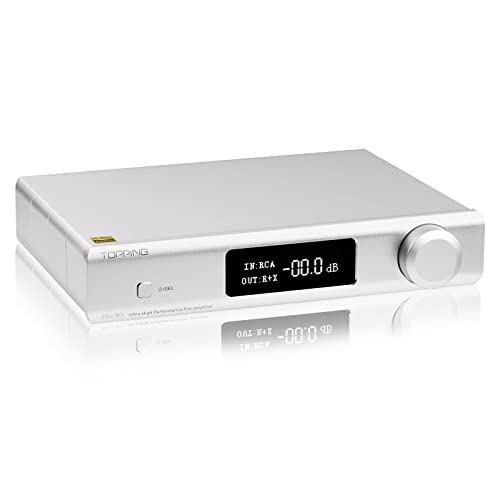
Fully balanced solid-state analog line preamplifier with NFCA modules and relay-switched stepped attenuator, delivering instrument-grade measured performance at a moderate price point.
Overview
The Topping Pre90 is a fully balanced analog line preamplifier launched on 2020-12-07 by Guangzhou Topping Electronics & Technology, built around the company’s proprietary NFCA (Nested Feedback Composite Amplifier) modules and a Japanese-relay-switched resistor-network stepped attenuator. Topping has built its brand on measurement-first audio electronics, and the Pre90 sits as the dedicated line-stage piece of the A90/D90/L70 ecosystem, currently priced at 599 USD with an optional Ext90 input extender at 249 USD [1].
Scientific Validity
\[\Large \text{0.9}\]Manufacturer specifications state THD+N of <0.00007% (1 kHz, A-weighted), S/N ratio of 137–145 dB depending on input/output configuration, dynamic range up to 145 dB, frequency response of 20 Hz–100 kHz (±0.1 dB), and channel separation greater than 130 dB at 1 kHz [1]. Third-party measurements from Audio Science Review confirm SINAD equivalent to approximately 124 dB at 4 V XLR balanced output, with combined noise and distortion reported as roughly 5 dB below the audible threshold, indicating excellent distortion performance [2]. Stereophile measures S/N at 121.5 dB A-weighted referenced to 2 V output, frequency response flat in the audioband with only -0.5 dB attenuation at 100 kHz, and channel separation of 110 dB below 2 kHz falling to 90 dB at the top of the audioband [3]. IMD performance is rated by ASR as on par with the Benchmark HPA4 reference [2]. Overall measured performance is excellent across frequency response, S/N ratio, dynamic range, THD, crosstalk, and IMD.
Technology Level
\[\Large \text{0.6}\]The Pre90 is an in-house Topping design built around its proprietary NFCA composite-amplifier modules paired with the UHGF (Ultra High Gain Feedback) architecture, driving a Japanese-relay-switched resistor-network stepped attenuator with 0.5 dB resolution in a fully balanced chassis [1][2]. The topology was genuinely advanced when introduced in 2020 and reflects accumulated know-how across the A90/Pre90/L70/LA90 module family. Five years on, competing measurement-focused brands have reached comparable or slightly better SINAD with similar feedback-intensive solid-state approaches, so NFCA is no longer cutting-edge and the competitive moat is shallow. UHGF in particular is a proprietary label wrapped around a generic high-loop-gain feedback principle. Technology integration with digital control, IR remote, 12 V trigger, and per-input/output memory is competent but standard for the segment.
Cost-Performance
\[\Large \text{0.6}\]Current market price is 599 USD at Topping’s official store and Amazon US [1]. The cheapest equivalent-or-better product identified is the Topping L70 at 349 USD [4], which is also an NFCA-based fully balanced design measured by the same third-party lab [5].
CP = 349 USD / 599 USD = 0.58
The Topping L70 demonstrates equivalent-or-better measured performance and provides the same essential user-facing functions:
- SINAD: 120.4 dB vs ~124 dB (XLR balanced, ASR) — equivalent (within ±5% window) [5]
- THD+N: <0.000055% vs <0.00007% at 1 kHz A-weighted — L70 better [5]
- Dynamic Range: 146 dB vs 145 dB (manufacturer) — L70 better [5]
- Frequency Response: flat in audioband for both, per ASR — equivalent [5]
- Maximum Output Level: 52 Vpp vs 50 Vpp balanced — L70 better [5]
The L70 matches the Pre90’s XLR balanced and RCA single-ended line-level inputs/outputs, IR remote control, relay-switched stepped volume attenuator, 12 V trigger, and front-panel display, while additionally offering a multi-output headphone amplifier stage and a ground-lift switch as bonus functions. Since a cheaper product with equivalent-or-better functions and measured performance exists, the Pre90’s cost-performance is moderate rather than class-leading.
Reliability & Support
\[\Large \text{0.5}\]Topping’s standard manufacturer warranty for the Pre90 is 1 year of free repair, with a 30-day replacement window for the main unit [1]. This is slightly shorter than the typical 2-year baseline, though several authorized dealers extend the term to 2 years at their discretion. Construction is simple and inherently robust: the Pre90 is a purely analog line stage with no battery, no DSP, no internal moving parts beyond the rotary encoder and IR receiver, and an aluminum chassis. Support is routed primarily through authorized dealers worldwide with escalation to Topping in Shenzhen for repair, including out-of-warranty paid service. No Pre90-specific recall, service bulletin, or statistical failure data has been published. Firmware updates are not applicable because the signal path is entirely analog. The most commonly noted minor friction is limited IR remote range and angle.
Rationality of Design Philosophy
\[\Large \text{0.8}\]The Pre90 is explicitly designed around a measurement-first philosophy: solid-state, fully balanced, MCU-controlled, relay-stepped attenuator, and low-power (6 W in operation), with marketing expressions unrelated to sound quality excluded [1][2]. Manufacturer claims are numerical, expressed in the same units that third-party labs measure, and broadly consistent in order of magnitude with ASR and Stereophile results [2][3]. Cost allocation focuses on components that affect measured performance — NFCA modules, Japanese relays, balanced topology, MCU control — without spending on parts unrelated to sound quality; the chassis is a compact 1.12 kg metal box. The modular Pre90 plus optional Ext90 input extender lets buyers with one or two sources avoid paying for inputs they will not use. The 2 kΩ balanced input impedance is a deliberate noise-performance trade-off rather than a marketing claim, and is the only meaningful pairing consideration. Performance progression across the Topping line is consistently upward in measured metrics.
Advice
If your priority is a transparent, low-noise balanced line stage with relay-stepped volume control and remote operation, the Pre90 delivers instrument-grade measured performance and matches reference-class solid-state preamps costing several times more. However, before purchasing, consider that the Topping L70 at 349 USD offers equivalent-or-better measured performance with the same essential I/O and control functions plus a headphone amplifier — making it the more cost-rational choice unless you specifically need the additional inputs offered via the Ext90 extender or prefer a dedicated line-only chassis. Confirm that your source components have output impedance well below 2 kΩ on their balanced outputs to avoid level loss into the Pre90’s balanced input.
References
[1] Topping Official Store - Pre90 Hi-Res Balanced Preamplifier product page - https://www.topping.store/products/topping-pre90-hi-res-balanced-preamplifier - accessed 2026-05-25
[2] Audio Science Review - Topping Pre90 Review (preamplifier) by Amir Majidimehr - https://www.audiosciencereview.com/forum/index.php?threads/topping-pre90-review-preamplifier.18283/ - accessed 2026-05-25 - Audio Precision, XLR balanced, unity gain, 4 V output
[3] Stereophile - Topping Pre90 line preamplifier Measurements by John Atkinson - https://www.stereophile.com/content/topping-pre90-line-preamplifier-measurements - accessed 2026-05-25 - Audio Precision SYS2722, A-weighted, ref. 2V output
[4] Apos Audio - Topping L70 Headphone Amp product page - https://apos.audio/products/topping-l70-headphone-amp - accessed 2026-05-25
[5] Audio Science Review - Topping L70 Headphone Amp Review by Amir Majidimehr - https://www.audiosciencereview.com/forum/index.php?threads/topping-l70-headphone-amp-review.39767/ - accessed 2026-05-25 - Audio Precision, XLR balanced output measurements
(2026.5.27)
External Search
Check additional information and availability outside this site.