
Product Review
Tannoy Prestige Kensington GR
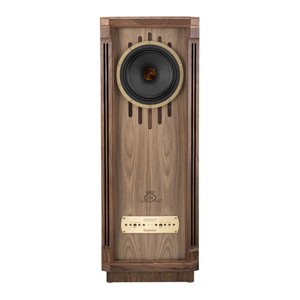
A heritage passive floorstanding speaker at 19,790 USD per pair with Tannoy's Dual Concentric driver. Measured frequency response shows a significant +8 dB bass peak at 55 Hz. Strong structural reliability from its passive all-analog design. Cost allocation heavily favors heritage materials and aesthetics over acoustic optimization; the MoFi SourcePoint 888 delivers a measured FR deviation of 2.6 dB at 4,999 USD per pair.
Overview
The Tannoy Prestige Kensington GR is a 2-way passive floorstanding loudspeaker and the third model in Tannoy’s five-tier Prestige Gold Reference series. Founded in the UK in 1926, Tannoy introduced the Dual Concentric coaxial driver in 1947 — a design in which the high-frequency compression driver fires concentrically through the center of the low-frequency cone, creating a single acoustic point source. The Kensington GR uses a 250 mm (10”) version of this driver with an Alnico magnet motor system, mounted in a hand-built high-density birch plywood cabinet with real walnut veneer and extensive internal DMT bracing. The crossover uses ClarityCap MR capacitors and underwent deep cryogenic treatment during assembly. It is sold at approximately 9,895 USD per unit (19,790 USD per pair) through authorized US dealers, with the Prestige GR series launched in 2013–2014 [1].
Scientific Validity
\[\Large \text{0.5}\]Manufacturer specifications state a frequency response of 29 Hz – 27 kHz (–6 dB) and nominal sensitivity of 93 dB (1 W/1 m) [1]. An on-axis frequency response measurement by Hi-Fi World reveals a narrow-band peak of approximately +8 dB centered at 55 Hz, a sharp rolloff below 40 Hz, and treble beginning to roll off above approximately 10 kHz; the midrange is described as generally flat [2]. Measured sensitivity was 91 dB, and measured nominal impedance was approximately 6 ohms (minimum DCR 5.7 ohms), versus the manufacturer-stated 8 ohms [2].
The +8 dB bass peak represents a substantial frequency response deviation. The midrange flatness is a mitigating factor but does not bring the overall response within acceptable limits. No harmonic distortion measurements were located from any source for this product. S/N ratio, SINAD, IMD, and crosstalk are not applicable metrics for a passive loudspeaker without active electronics. The available measurement data — limited to one publication’s on-axis FR plot with no anechoic spinorama data — forms the basis for this score.
Technology Level
\[\Large \text{0.4}\]The Kensington GR is an in-house acoustic design manufactured at Tannoy’s Scottish facility. The Dual Concentric coaxial point-source driver is Tannoy’s original invention, and its specific implementation reflects substantial accumulated manufacturing expertise in this driver architecture. However, the coaxial driver concept is now widely implemented by multiple competitors without licensing Tannoy’s technology, reducing its technical differentiating value.
The Alnico magnet motor system was phased out across the loudspeaker industry by approximately 1978, replaced by ferrite and later neodymium magnets for both cost and performance reasons. Deliberately reintroducing Alnico as a premium heritage material choice is not a technical advancement, and claimed sonic benefits have not been confirmed by independent controlled measurements. The crossover’s deep cryogenic treatment lacks peer-reviewed acoustic measurement evidence of audible benefit. The product is entirely passive and analog with no digital integration. The GR revision over its predecessor introduced upgraded crossover components — ClarityCap MR capacitors, laminated core inductors — and a new cone material, representing incremental improvement rather than fundamental innovation. No active patents protecting unique technical content were identified.
Cost-Performance
\[\Large \text{0.3}\]The Kensington GR is priced at 19,790 USD per pair [1]. As a passive loudspeaker, the essential user-facing requirements are passive operation via standard binding posts, adequate frequency range, and adequate SPL capability.
The MoFi Electronics SourcePoint 888, available at 4,999 USD per pair [4], provides equivalent or better measured performance. Measured by Erin’s Audio Corner using a Klippel Near-Field Scanner [3]:
- Frequency response deviation (300–5,000 Hz): SourcePoint 888 = 2.6 dB (Klippel NFS). The Kensington GR shows a qualitative +8 dB peak at 55 Hz per Hi-Fi World [2], making the SourcePoint 888 measurably superior on this axis.
- Bass extension (–6 dB): SourcePoint 888 = 30.0 Hz (measured). Kensington GR = 29 Hz (manufacturer spec) — a difference of 3.4%, within equivalence tolerance.
- THD: Measured at 86 dB and 96 dB SPL for the SourcePoint 888 with adequate performance confirmed [3]. No THD data is available for the review target.
The SourcePoint 888 is equipped with standard passive binding post connectivity and equivalent bass extension; its measured FR deviation of 2.6 dB is substantially better than the review target’s measured response. This comparison is provisional, as no numeric anechoic FR measurements exist for the Kensington GR.
CP = 4,999 USD ÷ 19,790 USD = 0.25
Reliability & Support
\[\Large \text{0.9}\]The Kensington GR’s passive, all-analog construction — no amplifier boards, DSP circuitry, or electrolytic capacitors — inherently minimizes electronic failure modes. The fabric driver surround introduced in the GR generation has demonstrated substantially better durability than the foam surrounds used in earlier Prestige models. Third-party specialist repair services for crossover work and driver reconing are independently available and documented.
The US market warranty is 3 years upon registration with Music Tribe within 90 days of purchase [1]. Music Tribe provides global manufacturer support via its Empower Tribe network with authorized service fulfillers by country. The product line’s long manufacturing history, with Dual Concentric passive speakers produced continuously since 1947 and many vintage units remaining in service, constitutes a credible long-term reliability track record. The only documented physical concern is tip-over risk due to the tall, narrow cabinet (1,100 mm height) with a high center of gravity; metal feet and carpet protectors are supplied. No statistical failure rate data for the GR series is published, and no manufacturing defect pattern was identified in available sources.
Rationality of Design Philosophy
\[\Large \text{0.1}\]The Kensington GR’s development philosophy is deliberately backward-looking. Alnico magnets, phased out across the loudspeaker industry by approximately 1978, were reintroduced as vintage premium positioning — not as a technical improvement over ferrite or neodymium alternatives. Deep cryogenic treatment of the crossover, claiming to improve the “crystal structure of conductors,” has no independent controlled acoustic measurement evidence. Internal silver/PCOCC wiring claims no demonstrated measured advantage over standard copper at speaker-level signal conditions.
At the GR’s launch in 2013–2014, DSP room correction systems and measurement-optimized passive speakers with neodymium drivers were commercially mature alternatives. The entirely passive Alnico-based design at this price point reflects an ideological stance rather than a technical constraint. The SE-to-GR revision introduced crossover component upgrades and a cosmetic redesign but produced no documented measurable acoustic improvement, while the price increased substantially. Multiple manufacturer performance claims — Alnico “cleaner transient response,” cryogenic treatment sound quality benefits — have no independent controlled measurement verification. The majority of the 19,790 USD per pair price is directed toward heritage materials, artisan cabinetry, machined metalwork, and brand premium, with a comparatively small share toward acoustic performance optimization. The product functions as a loudspeaker and delivers genuine acoustic output.
Advice
The Kensington GR is suited to buyers who explicitly value Tannoy’s Prestige heritage, hand-built construction, and cabinet-as-furniture aesthetics, and who accept that a significant share of the 19,790 USD per pair price reflects these non-acoustic factors. Its passive all-analog design offers strong long-term structural reliability, and the 3-year registered warranty with globally available manufacturer support is a genuine advantage.
Buyers for whom measured acoustic performance is the primary criterion should note: the on-axis frequency response shows a +8 dB peak at 55 Hz per Hi-Fi World measurement [2], and no independent anechoic THD data exists. The MoFi Electronics SourcePoint 888 achieves a measured FR deviation of 2.6 dB (Klippel NFS) at 4,999 USD per pair [3][4] — substantially lower bass deviation at approximately one-quarter of the price, with independent high-resolution anechoic measurements confirming its performance. For buyers prioritizing measurement-verified acoustic performance, alternatives with independently confirmed anechoic data represent substantially better value.
References
[1] Upscale Audio — Tannoy Kensington Gold Reference Loudspeaker (each) — https://upscaleaudio.com/products/tannoy-kensington-gold-reference-loudspeaker — accessed 2026-05-31
[2] Hi-Fi World — Tannoy Kensington GR, Measured Performance (page 5) — https://www.hi-fiworld.co.uk/index.php/loudspeakers/65-reviews/745-tannoy-kensington-gr.html?start=4 — accessed 2026-05-31 — on-axis FR plot, impedance curve, 200 ms cumulative spectral decay; measurement conditions not specified
[3] Erin’s Audio Corner — MoFi Electronics SourcePoint 888 Tower Speaker Review — https://www.erinsaudiocorner.com/loudspeakers/mofi_soucepoint_888/ — accessed 2026-05-31 — Klippel Near-Field Scanner; FR deviation 2.6 dB (300–5,000 Hz); F6 30.0 Hz; sensitivity 85.6 dB
[4] Audio Advisor — MoFi SourcePoint 888 — https://www.audioadvisor.com/prnt-mosp888-blk — accessed 2026-05-31
(2026.6.1)
External Search
Check additional information and availability outside this site.